I was just walking through downtown Vegas when a cover band started up with a familiar tune. Presented here so you can take the same trip down memory lane to the late 1970s that I did.
Saturday, October 29, 2011
Time Warp


Thursday, October 27, 2011
I don't know what to say
I just looked at today's installment of "+EV." I've been reading this poker-themed web comic strip forever and generally like it. But today? Stunned is all I can say.
Go take a look.
I'm hardly the most politically correct or oversensitive guy on the planet. But explicitly and casually lumping together Africa, blacks, and tribal cannibalism, and expecting that readers will find in it light amusement, demonstrates an ear far deafer to contemporary sensibilities than I think I can be accused of ever having been.
Didn't humor of this variety die out about the time that Amos and Andy went off the air?
Addendum, October 28, 2011
As commenters have noted, the link above no longer works, and the cartoon in question appears to have been taken down from the site. The archive is here, and the one for October 26 doesn't show up there. I have no knowledge of what happened, but since the comic's author submitted a comment here defending his work, I doubt that he had a sudden change of heart. Given that the series is sponsored by a prominent online poker site, I would venture a guess that the sponsor was displeased to see its name on that particular strip and asked that it be removed.
I saved a screen shot of the page, anticipating that something like this might happen. (Somehow the top edge and a few words of the text got cut off, and I didn't notice it until now.) I didn't post this at first because I preferred to direct traffic to the site of the original. But since it's not there anymore, there's no way for people to see what I was describing. For that reason, I post it below.

Heart Attack Grill
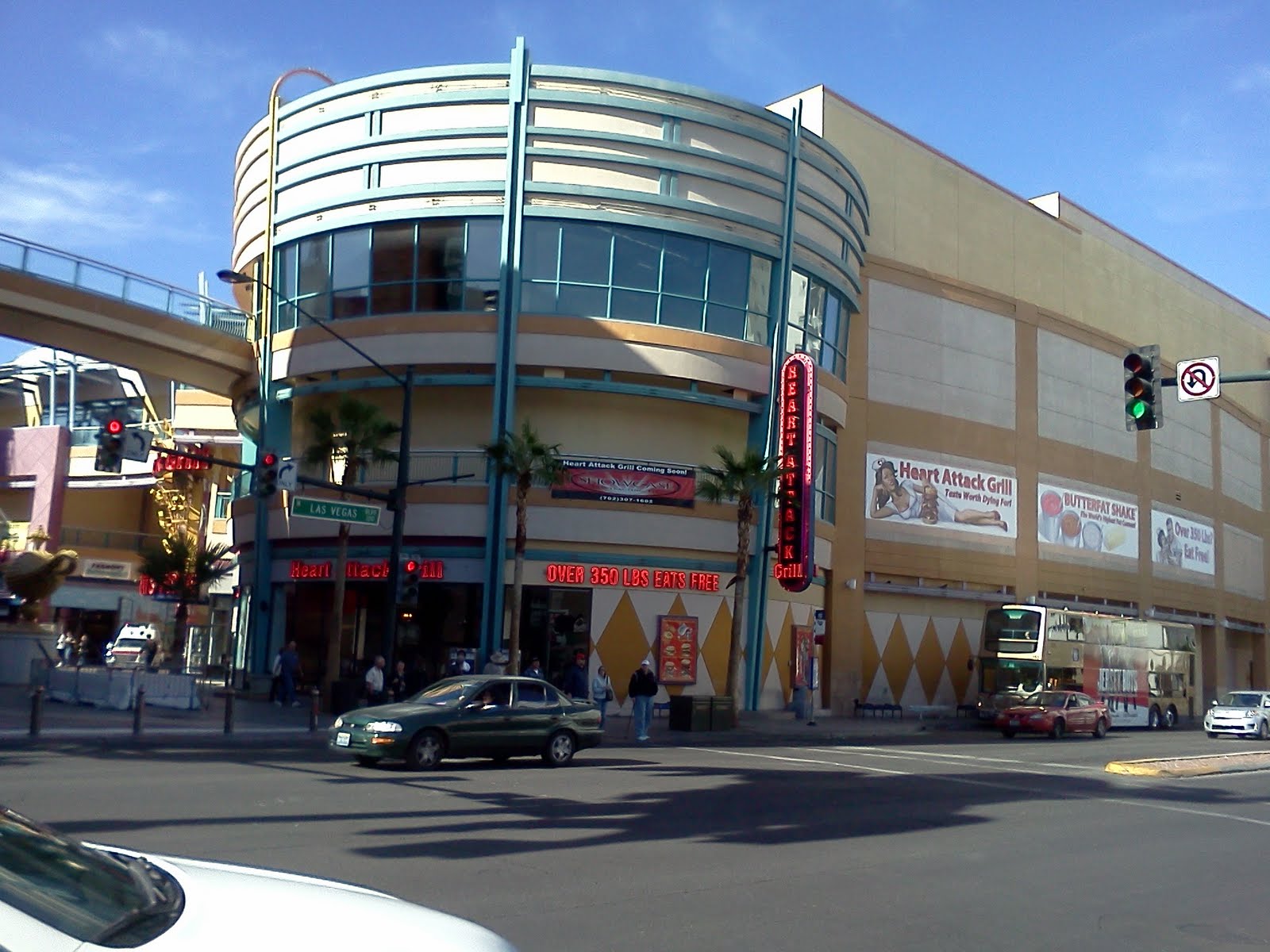

Today I met a friend for lunch at the new Hash House a Go Go inside the Plaza downtown. On my walk there, I passed another new restaurant that I don't think was there last time I went by. It's the Heart Attack Grill. As you can see from the big sign that hangs outside of it, if you're over 350 pounds, you eat for free. Their waitresses are dressed as nurses, and customers are given hospital gowns to wear while they eat. The burgers--which seems to be the main fare on the menu--are graded single through quadruple "bypass." You can get a side dish of "Flatliner Fries." Etc.
I'm not sure whether to be amused or appalled by the whole thing.

Tuesday, October 25, 2011
Not happy with Poker Tracker

I'm still in the free trial period for Poker Tracker 3, and I'm sure glad they offer one, because I'm not feeling inclined to buy it, and if I had paid for it, I would be getting even more irritated with the product than I am now.
It's buggy. At least three times the HUD has vanished for no apparent reason in the middle of a game (or two or three), and the software won't respond to any commands. I have had to resort to the Task Manager to force it to shut down, then restart.
It also occasionally does weird things such as shown above. I was doing two SNGs at a time, as I commonly do. It seemed to be working normally, but then the HUD blinked off on the game on the right. It took me several minutes to notice that the HUD on the game on the left had changed in a rather important way at the same time: It was now showing me stats for the seats on the right-hand game! If you look closely, you can see that the names in the HUD match the corresponding seats in the other game. If I had changed the display to omit the players' names in order to save screen space, as one commenter suggested when I first installed the program, I would never have noticed this, and would have been relying on completely false numbers. That is completely unacceptable. Erroneous data is far worse than no data at all.
And it does compile erroneous data. In one game, I raised the very first hand with K-K and won, but for another 20 hands or so, until I raised pre-flop for the second time, it continued to show my pre-flop raising percentage for that table as zero. Yes, Tracker had been on and set to import hands well before the SNG started. That makes me wonder what else it's missing or getting wrong that I haven't noticed.
The HUD blinks off for several seconds when it's updating. Annoyingly, this is often right when I need it most, when somebody has put in a raise and I want to evaluate how much weight to give it. BOOM--HUD is off for five seconds or so, and I don't know how long until it will be back. Extremely irritating.
I had heard that one needed to do periodic maintenance on the database in order to keep it from getting bogged down. I went to the web site for "how-to" instructions on this. The options for how to do this maintenance were baffling. I'd like to think that I'm a pretty smart guy, and I definitely have more education than any decent person needs. But I could not make heads or tails of what this section of the FAQ was trying to tell me to do, nor why.
Similarly, I had noticed a feature about marking hands for later review. Great. I figured out how to mark one during a game. But then I wanted to find it to, y'know, do the "later review" part. Checked all the menu options and tabs I could find--nothing. Went to the web site, finally tracked down a couple of places where people were talking about this feature in the forums. Apparently I am not the only one to be confounded by how to employ this feature, because there was more than one question about "where are the marked hands?" But even when I tried to follow the instructions provided, I couldn't. I simply could not find the sequence of steps/options they were trying to get me to follow. Again I emphasize that I'm not a generally dense or helpless person. I can nearly always get computers to do whatever I need them to do, and I can follow directions as well as the next guy. If I can't figure out how to do something that should be incredibly simple--like find a hand marked for later review--even after I've read your instructions, then the software is badly designed, the instructions are poorly written, or both.
My final gripe is that the HUD doesn't do one of its most basic tasks consistently, at least on Bodog. If there is a bet and call on the river, the little "after-image" display will show only the hand(s) that Bodog showed itself. If the loser mucks without showing, the HUD will not display those cards, even though I can retrieve that information by going into Bodog's "last hand" history. In other words, the data is there, but not displayed. The ability to skip the time-consuming and distracting step of opening the last-hand history page was one of the chief reasons I wanted a HUD in the first place, and the damn software won't do it consistently.
I know that this is a very powerful analytic tool. Maybe I have something set wrong. But good software design makes at least the most basic and commonly used features easy to find and use. With good design, a user should be able to ask himself, "What would be the easiest or most obvious way to make X happen?" and then find that, lo and behold, that is exactly what works. Tracker has not even a trace of such thoughtful design. Most likely there are solutions to all of my problems, were I to invest enough time to learn the ins and outs, and navigate the thicket of bewildering menu options. But I don't want to. I want to play poker, I don't want to play Poker Tracker. It's supposed to be a tool that helps me, not something that requires more attention than the game itself. Tracker may be like the power of a snarling Lamborghini, but I really want something as simple and reliable as a Toyota Camry. I'd happily forego a complex feature set for ease of use and dependability.
The bottom line: In addition to being buggy and unreliable, the program is complex, obtuse, opaque, and mysterious even when it's working the way it's supposed to.
It's time to download Hold'Em Manager for its trial period and see if it's any better suited to my needs and expectations.
Sunday, October 23, 2011
"See a lot of cheap flops"
My friend Josie posted about a big tournament she recently played at Foxwoods, here. She says, "My modus operandi was to try to see alot of flops on the cheap and early. My guideline for these cheap flops was that I had to hit better than one pair to keep going otherwise muck after the flop."
What follows is the comment I left on her blog. But after submitting it, I decided that I might as well post it here, too, since I spent some time writing it, and perhaps readers will find it useful.
You didn't ask for my advice, but I think that is a lousy plan.
One of the best gems of poker wisdom I've ever come across is this, from John Vorhaus: "There's nothing more expensive than a cheap flop." (http://pokergrump.blogspot.com/2008/08/poker-gems-155.html)
The first problem is that if somebody raises behind you, you are faced with choosing between (A) abandoning the chips you already put in, or (B) playing a weak hand against a raiser from out of position. Not a very attractive pair of options, is it?
The second problem is that you are relying on hitting a hand in order to win. So is everybody else limping in. You have no better chance of flopping a monster than anybody else. Playing this way levels the playing field and eliminates whatever edge in skill you might have. You're turning a poker tournament into a game of bingo.
The third problem is that the great majority of the time you will not flop a monster, and you'll have to fold. This is a big leak of chips. Ever seen a water bill when you had a leaky faucet you didn't know about? Drip, drip, drip, one big blind at a time, your stack leaks down the drain. It is mathematically demonstrable that over the long run you will not win enough when you hit to make up for all the small losses you take along the way.
As a general rule, calling (preflop or postflop) should be your LAST option. There are definitely situations where it is the best route, but you should always first try to find a reason for an aggressive action (bet or raise), secondly consider folding, and only if it's clear that neither of those is optimal consider a call. You are turning that basic, sound, universal strategy on its head by making a call your first choice.
I defy you to find any well-regarded tournament strategy book or successful tournament player who advocates the approach you're describing. I'd bet you $100 you can't find one. There's a reason for that: IT'S A TERRIBLE STRATEGY THAT ONLY WEAK, LOSER PLAYERS EMPLOY!
Don't be one of them.
Now that I'm in my own forum, I can add a couple more thoughts.
Yet another disadvantage of this plan is how transparent it makes your hand when you do finally catch a flop. Opponents know that you're limping a lot, but you're presumably still raising with your best starting hands. Ipso facto, they know even before the flop that you don't have a big pair, A-K, A-Q, etc. They also know that when you limp, this is followed by a fold on most flops, which sets you up to be bluffed the 98% of the time that you don't flop two pair or better. If you do bet or play back at their flop bet, they'll know you have a real hand, and they can give up with only a small loss--which means only a small win for you.
Josie's post gave a concrete example of how this knowledge can be used, though in this case to her advantage. She had 10-6 on the button, with a flop of A-A-6. She called down a bluffer, confident that he didn't have an ace because he didn't raise pre-flop. Fine. But others can use exactly the same logic against you. You can't credibly represent having the ace the same way you could if you had raised on your button in that spot.
A far, far better strategy is frequent, small raises. Make the same size raises with, say, 20% of your starting hands, consisting of a mix of big pairs, unpaired Broadway cards, small pairs, suited connectors, and a few random fliers, and your opponents will never be able to know whether you're betting the flop for value, as a bluff, or on a draw. When they are reduced to pure guessing about your hand, they will make a lot of mistakes, which translates to chips going your way.
An alternative to making exactly the same size raise every time (say, 2.5 big blinds) is to vary it according to your position and the number of players who limped in ahead of you. That is, you generally want to play bigger pots when you have better position, smaller pots when out of position, all else being equal. You can also sensibly raise more after a bunch of limpers than when everybody has folded to you, because the pot has already grown, and you want to make the pot odds less attractive for the bottom-feeders. But the size of your raise should never be dependent on the strength of your down cards. Bet sizing tells are among the easiest for opponents to spot patterns in.
Limping begets limping. You may be excited when your 6-5 offsuit hits a 9-6-5 flop, but the guy who you let in cheap with 9-6 likes it even better, and may take your whole stack. He would have folded if you had raised with your little connectors.
Limping makes exactly nobody afraid of you. Limping never forces your opponents to make a difficult decision.
Finally, consider this: You never win the pot pre-flop by limping. You can never steal the blinds with a limp. You never induce a better hand to fold by limping.
I certainly understand the appeal of the "see a lot of cheap flops" approach. It's low-risk, loses chips only slowly, and once in a while scores you a big pot. It also is relatively simple to execute, requiring few hard decisions. But it simply cannot succeed over the long run. When it works, it's by sheer dumb luck going your way. That's no way for a skilled player to take on the game.
Not only does this make you look like a weak player, it actually turns you into a weak player. I don't think there is a single thing to recommend it.
My thinking on this subject was changed forever by reading a great column by Ed Miller, back in December of 2008. It's available online here, and I highly recommend it. He's talking about cash games, but the same principles apply to tournaments. Choice excerpts:
So, your [limping] strategy must rely mostly on making a hand and getting value for it. Unfortunately, that's the same strategy that your opponents will have. And that's the fundamental problem with overlimping; it creates situations in which you and your opponents are all playing roughly the same way. When everyone is playing the same way, no one has an edge....When I first read this, the phrase "make-a-hand poker" instantly struck a chord with me. It's one of those little nuggets that lodged deeply inside my brain. I will occasionally now catch myself playing this way (especially if I've stayed at the table for too long and I'm feeling fatigued), and that phrase will leap to the front of my mind as a self-scolding: "You're playing make-a-hand poker again, aren't you?" It will usually cause me to either return to my tight-aggressive baseline game, or decide that my A-game is gone and it's time to go home, both of which are much better choices than to stay in the loose-passive rut.
The bottom line is that when you overlimp, you're mostly hoping to make a hand and win a big pot, and yet it's hard to stack someone or otherwise win a big pot when the hand starts out limped seven ways. And to top it off, your opponents are also hoping to make a hand and win a big pot, and they're almost as good at doing it as you are. So, you just don't have a whole lot of edge....
When seven people see the flop in a limped pot, everyone is playing "make-a-hand" poker, and you don't have it much better than anyone else. But when you raise preflop and only one or two people call, often your opponents will be playing make-a-hand poker while you will be playing "I win if you don't make a hand." This scenario can offer you a much more significant edge over your opponents....
Overlimping is not at all universally bad. It keeps you in the hand and gives you some chance to win a big pot. And in very aggressive games where people are raising and reraising like crazy, overlimping can often be your best play.
But when the game is passive and many pots are being played five-, six-, or seven-handed for the price of the big blind, overlimping often handicaps you. It forces you to play primarily make-a-hand poker, and therefore it deprives you of many of your potential edges. Try raising instead. Doing so can tilt many pots to your advantage and enable you to exploit much larger edges. The bigger your edges, the more money you'll make.
So, Josie, if you find this way of thinking about the "see a lot of cheap flops" game plan enlightening, divide your thanks between Ed and me.
Guess the casino, #1019


To reveal the hidden answer, use your mouse to highlight the space immediately after the word "Answer" below.
Answer: Trick question! This is Casino Estoril near Lisbon, Portugal. With thanks for photos submitted by reader "VegasDWP."
Saturday, October 22, 2011
"Witty and provocative"?

My friend Shamus recently did a post for Epic Poker about the history of strip poker. It's one of his series on the role of poker in American culture, a subject about which he teaches a college course and is uniquely qualified.
The post refers to several movies I had never heard of before. Of them, the one I'd most like to see is the 1971 Milos Forman film, "Taking Off," but it is not available through Netflix. I settled instead on trying the 1940 production, "Mad Youth," which Shamus described as "witty and provocative."
I rarely disagree with Shamus as vehemently as I'm forced to here. The two adjectives I'd pick would be more like "execrable and soporific."
The whole thing is badly written and badly acted. The plot involves a lonely-hearts single mother who dates men through a male escort service, and her young-adult daughter, who likes to throw racy parties at home while mom's away. Strip poker is a part of these, though it occupies less than two minutes of the 63-minute feature. Not surprisingly, given its filming during the years of the Motion Picture Production Code, nothing is shown beyond the world's most unflattering and unrevealing underwear.
I guess we're supposed to be taught a lesson about how badly things turn out for youth as shockingly wayward as these, because the two principal female characters bizarrely end up forced into the sex slave trade in a locked-down brothel. Well, of course! Surely everyone knows that no other end is possible for people so shameless as to engage in showing their knickers to friends around a poker table!
Along the way, we have long detours for oddities like a guy pretending to be bullfighting his two dogs, and a falling-in-love story told through the turning pages of a diary. Really, the whole thing is just dreadfully bad. I'd even go so far as to call it unwatchable.
But if you want to decide for yourself whether it is better described as "witty and provocative" or "execrable and soporific," you don't even need to order the DVD from Netflix, as I did. You can just pop over to YouTube, here.
Don't say I didn't warn you, though.
The very picture of passivity

It's not hard to get a general feel for how a table plays. But once in a while, I'm finding that the numbers in Poker Tracker's heads-up display emphasizes some feature of the players more concretely and definitively than my unaided subjective sense conveys.
Above is a great example. I was aware that this table was playing more passively than most. But then I stopped and looked around the table at the numbers, and was floored by just how insanely passive it revealed the action to be.
Look at it. We've got "sallil" playing 46% of his hands, but raising only 4%. We've got "g ma" playing 45% of his hands, but raising only 3%. We've got "WhoUgunaCall" playing 25% of his hands, raising zero. We've got "player1901" playing 42% of his hands, raising zero. Finally, and most extremely, we've got "J5892" playing 54% of his hands, raising zero. Their aggression factors reveal that only one of them bet or raised post-flop more than he checked or called, and only two of them did so more than a third of the time.
(Me? Completely card dead. On the rare occasions that I got a decent starting hand and raised, I got a bunch of callers and then totally whiffed the flop, and was unwilling to bluff into a field full of calling stations.)
It's impossible to play this way profitably in the long run. I wonder how long it will take this bunch to figure that out. We can hope that they never do.
Kings take out aces, and more aces

This was a three-way all-in pre-flop. Kings taking out aces is not too rare. Kings taking out two pairs of pocket aces simultaneously, well, that's something you don't see every day.
What's in a screen name? #39

The hardest part of online poker tournaments for him is making it to the five-minute break every hour.
Guess the casino, #1018

To reveal the hidden answer, use your mouse to highlight the space immediately after the word "Answer" below.
Answer: Texas Station
Friday, October 21, 2011
Guess the casino, #1017

To reveal the hidden answer, use your mouse to highlight the space immediately after the word "Answer" below.
Answer: Sam's Town
Thursday, October 20, 2011
Calling all-in first hand with AK
In my recent post about my online SNG results, I included my self-assessments of the games in which I went out unusually early. One of them was having called an open-shove with AK on the very first hand of a tournament. I assessed the loss this way: "Guy went all in 1st hand with Q-9, I called with AK. He caught a 9. Definitely right move."
Commenter "Terry in Victoria" questioned this: "I just disagree on one thing where you called an all in on the first hand with AK. At best its a race for all your chips. Your a much better player than that and why risk them all when you can get your money in a much better times with less risk and more reward."
I'll admit that I had made my assessment on just a general sense that it was the right move, but this comment made me wonder. I decided to explore the question, since this is the kind of thing that math and modern poker software tools allow us to settle with a fair degree of confidence. It's a worthwhile question, because these low-stakes games have a small but steady number of players who shove all-in on the first hand no matter what they have and no matter what the action before them has been. I see it in maybe 15% of the games I play, so it's worth knowing how to respond to it.
First I went to an independent chip model calculator, here. If I lose, my equity obviously drops from 10% of the prize pool to zero. If I win, I go from 1500 chips to 3030 (doubling up plus the 10/20 blinds), which increases my prize-pool equity to 18.6%.
Let's assume that I call every time, and then set x to be the fraction of the time that I have to win in order to make the call profitable over a large number of trials. To simplify the math, I'll assume the prize pool to be $100. Then 18.6x (the amount I win) has to equal 10 (my original equity) to be a break-even call. X then must be 53.8%. I.e., if I win more than 53.8% of the time, it's a +EV move.
Next we have to figure out how A-K offsuit fares against the range of the shover. For that, the oddly named but wonderful PokerStove is the tool of choice. From it I learn that A-Ko is 65.3% to win against a random hand. That is plenty to make this a +EV call.
Now, one can still argue that it's not the best move, not on the basis that the call is -EV per se, but because one will likely be able to find spots to get it all in with even higher equity later. That may be so. I don't know, and I don't think it's a question that can be easily answered objectively. My gut sense, though, is that the call is indeed worthwhile.
Note that this calculation assumes everybody else will fold. A wrinkle is that that may not be so, and the hands with which one is likely to draw a second caller will be heavily populated with aces and kings, making it harder for my A-K to win. But I don't know how to account for that mathematically, so I'm conveniently disregarding it.
After finding the solution (or at least partial solution) to the case where I have A-K and the shover has any two cards, I wondered how much narrower his shoving range could be and the call still be a correct one mathematically. The answer surprised me. If an opponent is open-shoving not with every starting hand, but only with his top 50%, the answer changes only negligibly; I'm still 64.9% to win. If he tightens up and shoves with only the top 33% of his starting hands, I'm still 64% to win. Top 20% of his starting hands still leaves me with 62% winner, and even his top 10% of hands gives me 57%, just barely enough to be +EV.
The break-even point is if we somehow knew that he was only shoving with the top 7.4% of his possible starting-hand range, which means pairs 88 or better, suited aces with 10 or better kicker, unsuited aces with queen or better kicker, suited kings with jack or better kicker, and Q-Js. Maybe there exist players who adopt such a strategy (shoving with that range only), but I kind of doubt it. My impression is that those who open-shove do it with pretty much anything, hoping to get lucky and double up early or lose and start another game where they try the same gambit. These are not the world's most mathematical, analytical players.
An interesting related question is what range of hands I should call with if I know that my crazy opponent is, in fact, shoving on the first hand of the tournament with any two cards. Again my win percentage has to be about 54% to be mathematically correct. (I'm assuming the ideal case, where I'm either last to act and everybody else has already folded, or I somehow know that everybody else will fold behind me.) Top 50% of my starting hand range gives me 57.8% equity against a random hand, which is enough to do the trick. That's a huge swath of hands. I tried tightening it up somewhat: Any pocket pair, any suited or unsuited ace, and any two Broadway cards. That's about 28% of starting hands, and it yields 61.8% win equity, which is plenty.
I'm not sure I'll actually change my game to call that loosely--largely because of the fear of somebody else behind me overcalling with a much narrower range that has me crushed--but it's interesting and worthwhile knowing that the math says it works.
Guess the casino, #1016

To reveal the hidden answer, use your mouse to highlight the space immediately after the word "Answer" below.
Answer: Palms
Wednesday, October 19, 2011
Guess the casino, #1015

To reveal the hidden answer, use your mouse to highlight the space immediately after the word "Answer" below.
Answer: Luxor
Tuesday, October 18, 2011
200 SNGs
Every time I do a post about my poker results, either live or online, I think, "There can't possibly be anybody interested in this." But comments keep suggesting otherwise, to my puzzlement, so I venture again.
A little less than three weeks ago I reported to you about my first 100 single-table sit-and-go tournaments on Bodog. I have now completed the second 100. I mixed some $10 in, whereas the first 100 had been all $5. I also started tackling three games at a time instead of just two, and it is already more comfortable and less frenetic-feeling than it was the first time I tried it. Still, I can't pay as much attention to what individual players are doing, which bothers me. I have no idea how online specialists manage 20 or 30 tables at a time. I assume that, like most anything else, it's just a matter of gradual increases in facility of decision-making, but at this point it seems as impossible as climbing Mt. Everest would be for me.
As you can see from my nifty graph, I hit a rough patch there for a while, though I appear (and hope) to be just on the verge of climbing out of it with another upturn. I'm mostly good about avoiding going out on the bubble, but that bad patch included a sequence in which I bubbled four out of seven games, which was, I'll admit, pretty tilting.


My pattern of finishes has remained virtually unchanged:

I suppose that shouldn't be too surprising, since I haven't changed how I play in any noticeable way. In-the-money finishes are 36%, exactly the same as after the first 100. I still pretty well avoid the bubble and being the first or second one out. I also still score more firsts than anything else, which pleases me greatly. It makes me think that maybe there's something to this whole "poker is a game of skill" thing after all.
If I make the money, the most likely outcome is a win, the second most likely outcome is second place, and the least likely outcome is third for the min-cash. This is as it should be. There is no question in my mind that I have a measurable edge on most of my opponents when it gets to the end game. Most of them are either stupidly aggressive, pushing all in with ridiculous frequency (obviously afraid to make the harder decisions that come post-flop), or, alternatively, way too timid. In the latter group, they tend to limp every button, display obvious bet-sizing tells (mostly small bets with weak hands, big bets for big hands), and not bluff enough. Because my play is tight-aggressive during most of the tournament, they have learned to be afraid of my bets, and the combination of table image and a better knowledge of how to play two- and three-handed allows me to chip up against such players by running over them much more than they should let me.
My net profit after 100 games was $115. My net profit now is $185.
So if my pattern of finishes hasn't changed, why the lower profit per game? Simple: I'm doing less well in the $10 games than in the $5 games. In fact, my return on investment (ROI) is a little higher now than it was after the first 100 for the $5 games (1.25 compared to 1.21), but ROI for the $10 games is a dismal 0.88, with a net loss of $44.
You can go ahead and mock the fact that a player as experienced as I am struggles to beat $10 online SNGs. It doesn't worry me. My first run at the $5 games was negative for a while, too, until I adjusted my play to match the players. I've only done 34 of the $10 games compared to 166 of the $5. I'm confident I'll figure out what tweaks I need to make in compensation, given more time.
There is, in fact, a noticeable difference in the style of play moving up one notch--more than I would have expected. Sure, there's a lot of overlap, but I definitely see more thoughtfully aggressive play and less blindly aggressive play. In the $5 games, it's common to run into players who think that the way to run a bluff is to shove all-in, on the assumption that nobody can call a bet that big. Of course, what happens is that they only get called when they are crushed, and they get knocked out. That particular behavior is hugely profitable for the better, more patient players, and there is much less of it one level up. Players that lacking in fundamental understanding tend to choose the lowest buy-ins, and even the difference between $5 and $10 filters them out to a substantial degree.
I mentioned last time Cardgrrl's suggestion that I start keeping notes about my 7th- and 8th-place finishes. Why those spots in particular? Well, my 10th- and 9th-place finishes are mostly bad beats and cold decks. Those are early enough in the game that I'm not getting my whole stack in without strong reason to do so. If I lose, it's because it was something like a nut versus second-nut situation, or flopping a set and getting sucked out on with a straight or flush. There's not much room for examining and improving my play in those circumstances. The later finishes (6th, 5th, and 4th) are just run-of-the-mill stretches of dead cards, or appropriately gambling with a shove when short-stacked relative to the blinds, and it not working out. Again, it's hard to find systematic things wrong with my play that would keep those situations from happening.
But I have a lot of 8ths and 7ths, which are still early enough that a good percentage of them might be avoidable, and it's probably worth finding out if that is so. I added a "comments" line in my spreadsheet and now force myself to enter a brief evaluation of what happened. I try to be brutally honest with myself in chalking the results up to bad play versus bad luck. Here's what I wrote. (Some of these are for 10th and 9th-place finishes, too, when I thought there was something noteworthy.)
Overplayed big pair in face of resistance, shouldn't have lost. He had flopped 2 pr.Cold deck, QQ v. KK. OK with play.Bad beat cost much of stack, then open-shoved with 10-10 with 10 bb, called by KK.Prob bad play.AI on flop with pair and flush draw vs. top pair no draw, missed 14 outs x2. OK with play.Shoved pre with JJ over 4 bet, which was QQ. Bad play.3-outer on river. Played fine.Guy went all in 1st hand with Q-9, I called with AK. He caught a 9. Definitely right move.Made every kind of bad play.Horrible 3-outer on river after all in on flop.20 bb in SB, shoved w AK over apparent blind steal from big-stack button, he had 10-10, held.Cold deck. Overpair plus straight draw plus flush draw lost to one-bigger pair.Played fine. 15 BB, shoved with JJ over table's most frequent raiser, he had AK, caught A.Tried AI semibluff w flush and str draws against a player who had been getting frisky. He had flopped a set that time.Card dead. 11 BB shoved with 99, called by KK.Check-raise shoved with pair and flush draw, guy called with just two overcards, hit.Made stupid bluff attempt.Played fine, just unlucky everywhere.Stayed with second-best hands a couple of times when I should have folded.Cold deck--KK on dry flop, but guy had hit 2 pr.TPTK, he made disguised straight on turn. Unsure whether I overplayed it or it was reasonable. Really hard to put him on that hand.Card dead. Played fine.
There you have it--my confessional for all the world to see. Of course, any particular evaluation might be wrong and/or self-serving and/or the result of denial. I write them instantly after getting knocked out, usually while still playing one or two other games, so I can't devote too much time or attention to the analysis. Still, it gives me a sense of how much of these disappointing results can be attributed to me doing something stupid. It's more than I wish it were, but the first step to correcting a problem is acknowledging it, so maybe there's hope for me yet.
I have also just ordered Collin Moshman's book Sit 'n [sic] Go Strategy from Amazon. Maybe that will help me spot some leaks.
OK, that's enough navel-gazing for now. Onward and (I hope) upward. I'll report again after another 100.
Two more ways the Mighty Deuce-Four wins
Sometimes you bet at a flop that has no connection whatsoever with your Deuce-Four, and the competition just folds. I'm not entirely sure whether they somehow sense the power and run away in fear, or they are mind-tricked into being convinced they're beat. I guess it doesn't really matter.
Other times, you have Deuce-Four in the big blind, and everybody is wise enough to just throw their cards away, giving you a walk.


Subscribe to:
Posts (Atom)

 Posts

