I played in another of the occasional unofficial AVP home-game tournaments on PokerStars tonight. It was an eight-game mix (HORSE plus 2-7 triple draw, no-limit hold'em, and pot-limit Omaha). I conquered a simply MASSIVE field of eight players, taking home every last bit of the valuable prize money:
Along the way, I had this rather nice hand, though I couldn't get paid off:
Matt Matros, in Card Player magazine interview, July 11, 2012 (vol. 25, #14), page 34. Deep into a World Series of Poker event earlier this summer, he got all in with K-K versus an opponent's A-K, and lost the massive pot when an ace fell on the river.
There are going to be times when you go from the big stack to the short stack for reasons outside of your control and hopefully you've been through it enough to make a quick mental adjustment, shrug it off and continue to play your best. Having said that, I don't think I've ever experienced anything quite so drastic. Had I won that pot, I would've been the chip leader with about 1 million while second place held only 300,000. Instead, I was left with a below average stack.... I was a little shaken, but I started to look at the positives. I told myself that I was still in the hunt with 30 players left [out of] a massive field. Chances like that don't come around everyday [sic], so I could either sit back and complain about my bad luck, or really try to make the most of the opportunity.
[Matros recovered and went on to win the tournament ($1500 6-max no-limit hold'em), his third bracelet in three years.]
This morning I went for a hike in Red Rock Canyon with my friend Claudia, who is at the tail end of several weeks in town to deal for the World Series of Poker. We chose the trail to "Ice Box Canyon." We didn't get all the way to the end. We're both old farts and I, for one, am hardly in tiptop physical condition. Young whippersnappers were passing us as if we were standing still. Which, admittedly, we were quite a bit. Gotta rest a lot when you're decrepit. The roughly four miles we trekked was plenty, especially since at least a third of the distance was climbing over rocks rather than flat hiking in the usual Boy Scout sense. In fact, Claudia certified me as having done at least a week's worth of exercise, giving me permission to vegetate for the next seven days. So I've got that going for me, which is nice.
There simply does not exist nicer weather in Vegas in July than we hit today, and if there is more spectacular scenery anywhere within an hour of the city, I don't know what it could possibly be. We chose well.
I'm afraid I may have annoyed her with my frequent stops to take pictures. I was captivated by both the grand vistas and the small details. But I was simultaneously frustrated in advance, knowing that nobody short of Ansel Adams could do justice to the beauty surrounding us. Well, I tried.
We saw lots of lizards. I kinda like lizards. I think they're cute. Most were smaller than this sunbather. (For all photos, click to see somewhat bigger. Right click and select "open link in new tab" for the full-size shot.)
When I saw this shrub, I thought it was one of a kind. It's hard to tell what's happening, but it looks like the dead part of the plant sort of erupted out of the skin of the living part. I had never seen anything like it. But a short distance later, there was another just like it, then another and another. We passed dozens of them, all looking like the careful branch-by-branch fusion of a living brush and its dead predecessor. If anybody understands this odd botanical phenomenon, please enlighten me.
I think this is my favorite shot of the bunch. I looked back at one point and saw this lone, dead tree standing out in contrast to the sky and mountain ridge behind, and it bowled me over with its stark beauty. I had to leave Claudia for a few minutes and backtrack to find the best vantage point to capture it. I guess you could say I experienced an aesthetic emergency that could be addressed only by pressing a shutter release a few times. I'm afraid the result isn't as grand as what my visual cortex recorded. You'll just have to go find the spot yourself to see what I mean.
I think I was even less successful here. Maybe I'm weird to think that dead trees are lovely, but I do. The charring of this one, and the strange geometry created when it fell over, made it even more so, in my view. But again I don't think I managed to convey that adequately in the final shot. I was going for a 3-D-ish effect, with the near end of the tree coming right into the viewer's face. It seemed cool at the time, but when I see it on my computer screen--eh, not so much.
Your humble scribe:
And his lovely companion for the day:
And now this blog is pleased to present to you an assortment of the pretty rocks and mountains we saw, without further comment:
I see that the final nine of the WSOP Main Event have been determined since I went to bed. Every news story I have seen so far--and, I predict, every one I will see in the future--prominently mentions that two women were eliminated just short of the final table, in 11th and 10th places.
More troubling is that as Day 7 played out, my Twitter feed was full of people openly expressing their hopes that one or both remaining women would make the final table. Poker being a zero-sum game, if you hope that a female makes the final table and/or wins, it is the same as hoping that a male does not do so.
None of the people I follow on Twitter who hoped for the women to advance did so on the basis of knowing them personally, or because of them having superior poker skill and thus deserving the victory. It was entirely because of their sex, and for no other reason.
If you want for a good outcome to happen to one person and a bad outcome to happen to another person for no reason other than their respective genders, well, we have a couple of words in our language for what that makes you: (1) sexist, and (2) bigot.
I think I expressed this as well as I'm capable of doing four years ago when Tiffany Michelle was garnering attention for being the "last woman standing":
Yes, women are statistically under-represented at poker tables generally and in big poker tournaments specifically. But that is true of black people, too, so that fact does not constitute a rational justification for paying attention to one group but not the other.
If you privately are glad to see that a black person will not win the Main Event this year, then you are obviously a racist. Of course, if you are upset about the fact that a black person will not win the Main Event this year, then that makes you a racist, too. Similarly, if you hope that Michelle is eliminated because for whatever reason you can't stand the idea of a woman winning, you are sexist. And, in parallel, if you were rooting for her to win solely because of her gender, that, too, makes you sexist. It's all the same. If you favor or disfavor a person because of race, you're a racist. If you favor or disfavor a person because of sex, you're a sexist. You're a bigot either way.
One of the great things about poker is that it simply doesn't matter whether you're male or female, black, white, Hispanic, or Asian, young or old, tall or short, skinny or fat, physically handicapped or a perfect specimen of humanity. Not only is the game equally open to all, but none of those characteristics intrinsically impact one's ability to learn and succeed at the game.
Frankly, I find the attention heaped on female players in the spotlight demeaning to women. Every time there is attention lavished on a female player specifically because she is female, there is at least a vague undertone that she merits the attention because she's doing something one would tend to think she shouldn't be able to do, like a pig learning to play a Brahms piano concerto.
What would be most genuinely respectful of women, in my never-humble opinion, is silently accepting, as a simple matter of fact--so obvious that it's not even worth mentioning, let alone dwelling on--that women are just as capable of playing the game as men are.
To the media outlets and bloggers who focus on the Last Woman Standing, but completely disregard the Last Black Standing, I ask you to justify why you deem one worthy of your attention but not the other. Can you do it?
I think it should be noted that nobody either in or out of the poker media took me up on the challenge to explain why the sex of a poker player was newsworthy but race was not. I'm still listening, should anybody care to try.
People, people, people--when will you ever learn? Do not muck what you believe to be the winning hand until the dealer pushes you the pot. This is not that difficult a concept. You gain nothing by trying to jump the gun and muck them the first instant you think the hand is over, and once in a while you'll lose a great deal, as illustrated by a story from yesterday at the WSOP:
A few months ago, a friend of mine who lives in Australia wanted to organize a couple of get-togethers for people who, like him, participate in an online poker forum. He comes to Vegas for about six weeks every year. After consulting with potential participants about when they might be in town, he picked two dates, June 24 and July 8, both Sunday evenings. Between those two dates, nearly everybody who was interested in coming could make at least one of them.
I volunteered to make arrangements for small private poker tournaments. Because I live in town and know the poker rooms pretty intimately, I thought I was in a good position to pick spots. The poker room manager of the Riviera piped up on the forum, actively offering his facilities at a discounted rate, so that was half of the decision easily made. I could have done both nights there, but wanted to spread the business around a little, because I thought that people attending from out of town might not have seen other poker rooms and would appreciate the variety.
The first event at the Riviera was just perfect. They were great hosts and took really good care of us, taking pains to be sure that we all had a wonderful time. I could not have been more pleased. If you're ever have occasion to have a private poker tournament, I recommend that you put the Riviera near or at the top of your list of venues to consider.
The Tropicana, however, is another story. I spoke to the poker room manager by telephone in late April, explaining what we were looking for. He promised that he would come up with a proposal for a tournament cost and structure and get back to me. He did, several days later.
My first warning sign of trouble was that he clearly had me mixed up with somebody else for whom he was also negotiating a private poker event. He had the date wrong, he had the number of expected participants wrong, and he remembered that we had wanted to have pizza available, which is something I had not requested. But after getting those items corrected, he gave me his proposal, and I accepted it: July 8, 8 p.m., total of $75 buy-in. The tournament was to be followed by low-stakes cash games, and he promised (just as the Riviera had) to lower the usual rake for any cash games we started. I told him that exactly what games we played would depend on the preferences of those who showed up, but that something like the dealer's-choice mixed game that they regularly offer on Monday nights might be interesting to our guests. He said that would be fine, and if we did that, we could make it either $2/4 or $3/6 limits.
So it appeared that all was in place. Early Sunday I sent him an email as a final confirmation that all was in place. I did not get a reply (still haven't, in fact), but I didn't worry about this. I just assumed that the room manager had the day off and thus didn't see the message. In retrospect, I should have seen that lack of reply as more of a red flag than I did.
Just before 7:15, as I was getting ready to leave home, the first people to arrive were sending messages via Twitter that the staff of the poker room had no idea what private tournament they were talking about. Some small misunderstanding, I thought. So I quickly printed out a copy of the email the poker room manager had sent me containing the details and stuck it in my pocket as I headed out the door.
When I got there, it was as the others had said. The guy behind the desk knew nothing about it. Furthermore, he had in the interim called the room manager, who had claimed to know nothing about any private tournament. They had just one dealer on duty, running their one and only cash game.
I called the room manager. He said that there had been a flood in his office that destroyed his computer, and he had lost all of his emails for the last few months. I was highly skeptical of this story. (I related it to those who had arrived, and one of them quipped, "So he's telling you that the dog ate his homework." Yep--that's about it.) But he said that they always had dealers on call in case they got busy, and they could have someone there in about 20 minutes, and he would take $5 off of the house's portion of the tournament entry fee to help compensate for the misunderstanding. Fine--that was easier than trying to organize going somewhere else at the last minute.
The dealer arrived, sat into the cash game, and the one that had been in the cash game ran our single-table tournament. But when it was over, we were told that we couldn't open another cash game as we had planned; the dealer who ran our tournament was already on overtime and they couldn't keep him there any longer.
A few of us decided to go over to Bally's and play there instead. Others went their separate ways.
The whole thing was a disorganized mess from that second phone call on. I was embarrassed, because I had promised everybody that all was in place, and the failure made me look bad. (Admittedly I could have been more aggressive about rechecking before the appointed date to make sure that all was set. But I assumed that I didn't need to, that this guy was a professional at running his room, and that when he promised to be ready for a private poker tournament at a certain date and time, he would be.)
So what I said about giving consideration to the Riviera if you need to find a venue for a private poker event? Do the opposite for the Tropicana. Put them at the very bottom of your list, unless you relish the idea of your event being ignored and forgotten.
Now, see, I'm laughing out loud just typing out that post title. Sadly, only one reader will find it as funny as I do.
I was playing a few SNGs with Josie tonight, and IM-chatting with her on the side, when I had occasion to type that phrase. As I looked at it there on my screen, I thought, "There must come into existence a blog post with that title. It's too good to waste." I lamely suggested to Josie that she write one, but I don't think she will. So it falls to me.
The problem is that the story that generated the phrase, well, it just isn't very interesting, nor is it very funny. If I bothered to type it out, you'd all read it and think, "That's it?" Which is probably what you'll think when I end up leaving it a mystery, too. Oh well. Nothing I can do about that.
I guess you'll just have to take my word for it: Poopcorn must die.
Ed Miller's column in the June 27 issue of Card Player magazine is about bet-sizing tells. He walks the reader through a hand that he played while holding Q-Q, showing how opponents' bet sizes helped him deduce what hands he was up against. I have no quibbles with his reasoning. In fact, it's a highly worthwhile piece, and the sort of insight that makes me never want to miss his columns.
I do, however, have a quibble with an incidental point tossed in along the way. In explaining why he elected to just call rather than reraise when faced with an opening raise from a nit under the gun, he says:
[T]here are still five unknown hands behind me. There's about a one percent chance each player has either A-A or K-K, making about a five percent chance in total that one of the two hands I'm most afraid of is lurking behind me.
(Note: this is just one of the reasons he cites for not reraising, not the only one.)
At first I wondered why he was making a distinction between the players who have already acted and those yet to act. After all, A-A or K-K is an ugly problem for Q-Q no matter where on the table it is being held. But I think I see what he means. If he were in the big blind, and thus last to act on the raise, and nobody had reraised yet, then he could quite confidently assume that nobody was holding A-A or K-K, unless it is the UTG nit.
Or put it another way: Before there is any action, there is a fixed probability that any other player has been dealt a pocket pair higher than Q-Q. But people so reliably raise and reraise with A-A or K-K that when they fail to do so, we can safely revise downward that estimated probability.
What is the a priori probability that somebody at a ten-handed table has been dealt A-A or K-K when I'm holding Q-Q? It turns out to be a ferociously complicated mathematical problem, one that I could never solve on my own. Fortunately, though, somebody a lot smarter than me has already worked it out, and you can see both the process and the result here:
The table containing the solution is at the bottom of the page. The answer for Q-Q is 0.0841. That is, if I see Q-Q in my hand, and I have nine opponents, about 8.4% of the time one of them will be holding a pair bigger than mine. That does indeed work out to a round estimate of about a 1% probability that any particular one of them has the goods. And that's a useful rule of thumb. Before there is any action (action constituting additional information to throw into our estimation math), each player in a full ring game has about a 1% chance of having been dealt a pair higher than my queens.
If I'm in the big blind and nobody has raised, then probably nobody has a bigger pair, unless they're trying the ol' limp/reraise thing. Also, if I open-raise from under the gun with my Q-Q and get only callers with no reraise, I can go to the flop reasonably confident that nobody has A-A or K-K. But really, that fact has everything to do with what we know from experience about how people play, and little to do with the math. The conclusion would be equally true if the a priori probability of somebody holding a bigger pair were 80%, or 0.8%, rather than the actual 8%.
But I think there's a problem with how Ed applies the math to the situation he describes. Once a nitty player has opened for a raise from under the gun, we no longer have the baseline 8% chance that somebody at the table has A-A or K-K. The probability now has to be estimated to be vastly greater than that. Exactly how much greater depends, obviously, on exactly how nitty this particular nit is. If he is the extreme case and will only raise UTG with exactly A-A or K-K, then our previous 8% probability goes to 100%. Of course, it's not often you'll have a player with a range that narrowly definable, so it usually won't go up all the way to 100%. But it's surely a damn sight higher than 8%.
If the nit does, in fact, have A-A or K-K, then the probability that any other player at the table also has A-A or K-K is much lower than the roughly 1% apiece that we would otherwise be using as our rule of thumb. Using the next column in Alspach's table, we see that the a priori probability that two players have been dealt pocket pairs bigger than my queens is only about 0.2%--a negligible quantity. The implication is this: The fact that a nit put in an UTG raise means that the probability of a bigger pocket pair being out there is much greater than the baseline 8% (as just discussed), but also that nearly all of that probability resides in the nit, not in the players who will be acting behind me.
It is thus no longer true that each player behind us still has a 1% chance of holding aces or kings. Our estimate of the probability that any one of them has A-A or K-K must be greatly reduced from its baseline ~1% by the fact of having observed that UTG raise from the nit. Put most simply: As the probability that the UTG nit has aces or kings goes up, the probability that anybody else at the table has aces or kings goes down.
Now, this is where it gets a little weird and mind-bendy. Because two things are simultaneously true: (A) The probability that any player is dealt A-A is independent of whether any player is dealt K-K.* (B) Alspach's calculation of a 0.2% probability of two players having A-A or K-K is no longer valid once we actually know that one player has one of those hands. The 0.2% is valid only when we have no information except for having seen our own Q-Q.
This is analogous to questions such as the probability of a roulette wheel hitting 00 twice in a row. It is 1/38 x 1/38 = 0.026 x 0.026 = 0.0007. But if we spin and the ball falls in that 00 slot the first time, now the probability of seeing 00 twice in a row greatly increases, to 0.026. Of course, the probability that the second spin will be 00 has not changed one smidgen by virtue of the result of the first spin, yet the probability of seeing two 00s in a row has changed.
So it is with the A-A and K-K. If we know that the UTG player surely or almost surely has A-A or K-K, we have to throw out the window the Alspach table numbers. They no longer apply. The 8% probability (that exactly one player has A-A or K-K when I have Q-Q) is no longer valid because we have strong reason to believe that this specific shuffle of the deck did, in fact, result in one of those 8% events. And the 0.2% probability (that two players have each been dealt A-A or K-K when I have Q-Q) is no longer valid both for that reason, and for the reason that once the UTG nit is known to have A-A or K-K, two of those eight cards are no longer available to be given to other players.
The knowledge (or at least high suspicion) that UTG nit has one of the two premium pairs is akin to opening the sealed box in which Schrodinger's poor cat has been confined. It is now known to be either alive or dead, not in some hybrid or probabilistically indeterminate state.
Mind you, I don't claim to have worked out the math so as to be able to tell you exactly what the new, revised probability is that each of the five players yet to act has a pair bigger than Q-Q, in addition to the one that we presume is hiding under the nit's card protector, but it is definitely not well estimated by the 1% rule of thumb. It must be substantially lower than that. Exactly how much lower depends entirely on the degree of confidence with which we can assign A-A or K-K to the open-raising nit.
*Note: I realize that that is not quite true, because as soon as two aces are in a player's hand and no longer in the deck from which the dealer is pitching cards, the concentration of kings in the deck rises slightly by virtue of card subtraction, so the probability of K-K goes up slightly. But it's a tiny difference.
Last night I was playing at Binion's, Seat 1. Very early in the session I saw Seat 4 make a couple of very thin calls on the river (one of which was right and one wrong), and mentally pegged him as a calling station. Value-bet him, sez I to myself, no bluffing him.
Maybe an hour later I had been card-dead for quite a while, so I decided to raise with 10-8 offsuit from the cutoff seat. Most of my winning hands had been raise in position pre-flop, c-bet post, take it down. When the table is willing to let me do that, it obviously doesn't matter much what cards I have, as long as I'm not doing it so often as to arouse suspicion. I hoped that this hand would be yet another small win following the same pattern. The only caller was Seat 4 in the big blind.
Flop was A-J-9 with two hearts. Mr. Station checked. I thought this was a nearly ideal situation. I could represent the ace with a bet and have a high probability of ending the hand. If he called, I had an open-ended straight draw which, if it hit, would be thoroughly disguised, because he would never guess that I had open-raised with 10-8, given my tight image. If he were on a flush draw I could keep betting at any non-heart and likely win that way. If a heart came and he checked it, I could represent having made the flush. Lots of possibilities here for how to win this hand.
So I bet $15 into the roughly $20 pot. I was quite surprised to have him respond with a raise to $45. I didn't recall having seen him do a check-raise before. Yet I didn't get a sense from him of great strength, like a set. It felt more like a guy with an ace saying, "I don't think you have one." Very few players at these stakes check-raise a bare flush draw; rather, they use the check-raise to guard against opponents' flush draws. (The ace was one of the hearts, so he couldn't have top pair and a flush draw.) I considered my options, and settled on a call, hoping to either hit my hidden straight or get a heart which I could pretend completed my flush.
Turn was an offsuit 3. Whiff. I probably would have given up if he had made another substantial bet. But instead he checked. The check-raise/check pattern made me much more confident that, whatever he had, it was not a hand with which he was eager to get all of his chips in, which was a crucial point of demarcation. I took the free card.
River was the 4 of hearts. Now the question was what he would do. If he bet, I would have to conclude that he had flopped a pair and a flush draw, and abandon ship. But if he checked, then it would be much more likely that he hated the third heart than that he loved it.
Sure enough, he checked again. I moved all-in for my last $137. He sat back to think, and was pointedly studying me.
My usual practice when I am putting an opponent to a big test is to say nothing, no matter what. I rest my chin on my hands, remember to breathe normally, feel relaxed, kind of aimlessly look around at the pot, the TVs, the other players, or whatever else may be going on--and I try to do this exactly the same whether I have the stone-cold nuts or "what the little boy shot at."*
Here, however, the situation was somewhat different than usual. This guy was clearly suspicious, both by general disposition and because of the specific situation. Sure, I had played the flop and turn in a way that was consistent with a flush draw. The hole in the story, though, was that most of the time the pre-flop raiser will not have the flush draw when two of a suit come on the flop. The reason for that is simple: There are a lot more raiseworthy hands that contain different suits than are of the same suit, and even those that are of the same suit will be of a different suit than hits the flop three out of four times. If he was experienced enough to understand this truth, he was going to be leaning towards a thin call even more than was already his natural inclination. This was a high-risk, high-pucker-factor situation I was putting myself in. I felt that a little more salesmanship than usual was called for.
Very early in his tanking, he said, "Well, obviously you're saying that you made the flush. The question is, did you?" He quickly followed this with a friendly, "You're not required to answer that." Ordinarily I would ignore this or just give a small smile. But I wanted to stretch the envelope of my normal posture and conduct just a little toward the "I'm comfortable and relaxed" side, without overdoing it so much that he would recognize Hollywooding in me. So, playing off of what he had just said, I turned to the dealer and jokingly asked, "Do you have a player's Miranda warning here? Like, 'You have the right to remain silent. Anything you say can and will be used against you'?" The dealer and a couple of other players chuckled, which helped me to smile along with them and, I hoped, look like everything was right in my world.
This all went on for a long time--three or four minutes, anyway. He counted out the chips for a call, and looked at what he would have left if he lost. I watched him intermittently, but remembered not to freeze up in either my breathing or where I was looking, which is one of the more reliable signs of a bluffer. At one point he asked me the classic, "If I fold, will you show?" Again, I usually ignore such questions completely, but this time I fudged just a little on the looking-relaxed side by smiling nicely at him and giving him a "Gee, I just don't know what I'll do" shrug.
I really thought he was going to call. But finally he sighed, looked dejected, took one last look at his cards, gave them that resigned snap with the index finger (what IS that gesture about, anyway?), and passed them back to the dealer face down. Pot to me.
I did not show.
He said, "I don't think you had it." I just smiled. Seat 2 immediately opined to Seat 4, "I think he had you all the way." Seat 4 asked, "You think he could beat two pair?" Seat 2 said, "Oh yeah, he looked really strong to me. I think he was stringing you along." Seat 4 said, "Well then maybe I made a good fold."
Yes sir, you absolutely did. As John-Robert Bellande likes to say, "Excellent laydown!" Excellent for me, that is.
(From the post-mortem discussion, I'm thinking that maybe he had A-9 or J-9, and checked the turn out of worry that I had top two pair with A-J, but that's just a guess, obviously.)
*Wow. I haven't heard or used this phrase in years and years. I don't know why it just leapt to mind to deploy here. When my grandmother taught me how to play cribbage, if one ended up with a nothing hand, that's what she called it--"What the little boy shot at." For a nice little exposition on the history and meaning of this phrase, see here.
A couple of weeks ago I was playing the allvegaspoker.com (AVP) tournament at Mirage. A few seats to my right was a young man who was playing crazy. Within the first few hands, he open-raised to 20 big blinds, then shortly thereafter bet 4000 into a 1300 pot on the flop. This was not the stupid play of inexperience, but the carefree play of a very experienced player in a game being played for stakes he just did not really care about, trying to have some fun. Which is fine with me, but I want to get as much information as I can about what he's doing, because playing with him is going to involve high risk and variance.
He was seated next to a friend of his. One time when he made one of his stupidly big opening raises, his friend folded, then said, "Let me sweat you." So crazy guy showed him his hole cards. I knew right away that I would want to have that hand shown by the dealer if it didn't get exposed in the natural order of play. Furthermore, I was sure that the dealer had not noticed that little interaction, so I would have to be ready to explain to him what had happened. The dealer had a nametag identifying him as David, from Pennsylvania.*
At some point in the hand (I don't remember how far it went, and it doesn't matter), a bet from crazy guy went uncalled, and he won the pot. He traded his cards for the pot. As the dealer was sliding the cards toward the muck, I pointed at the cards and said, loudly and clearly, "Show those, please." I was sitting in the five seat, so the dealer and I were as close and as face-to-face as it is possible to get.
The dealer stopped his motion, the cards paused halfway between the player and the muck, and said, "What?" I repeated: "Show those, please."
The dealer absolutely, unquestionably both heard and understood me that time. But then he reacted in a bizarre way. He deliberately pulled the player's hole cards deep and irretrievably into the muck, gave me a puzzled look on his face, and only then asked, "Why should I show them?" Note that he mucked the cards before asking me that question, and did so entirely deliberately.
This seriously irked me. If he had just been moving too quickly to react in time to my first words, well, OK, such things happen. It's annoying, but I let it go. But this was intentional denial of my request, before he had even asked for, let alone heard, the reason why I was making it. Completely wrong and unprofessional.
So I explained: "That guy showed his cards to the player sitting next to him. That's why I was asking you to show them to the whole table."
The dealer said, "Oh, well you have to tell me that."
My God--can this guy really be this stupid?
I said, "I did tell you. What do you think the words, 'Show those, please' mean?"
He said, "People ask us to show hands all the time, without any good reason to. So you have to let me know that he showed them to another player."
I said--and I trust that the condescension in my tone of voice was perfectly obvious--"So the words, 'Show those, please' does not adequately convey to you that a player is requesting to see the cards?"
He said, "No."
I said, "OK, then, what are the magic words that cause you to actually do your job and show the cards that one player showed to another?"
He didn't have an answer ready for this instantly, but after thinking for a couple of seconds responded, "He showed his cards to another player, so you need to show them to everybody."
I repeated his proposed phrasing exactly, and asked him to confirm that I had it right. He did so. Then I further asked, "And that will get you to show the hand, but 'Show those, please' will not. Do I have that right?"
He was pretty fed up with me by this point, and snarled, "Yes."
I told him that I was glad to learn the magic words, because "Show those, please" worked in every other poker room in town, and it was important to know that the Mirage had a special magic phrase for that purpose. Again, I assume he could not have failed to miss the overt sarcasm in my voice.
So take this as a lesson. If you play poker at the Mirage, and if one player shows his cards to another player, and you want the dealer to enforce the "show one, show all" rule, there is only one specific sentence that you can use to accomplish that task: "He showed his cards to another player, so you need to show them to everybody." If you deviate from this specific formula one iota, the dealer will be obligated to ignore or deny your request.
At least that's what dealer David from Pennsylvania said was the rule and practice at the Mirage poker room. Surely he wouldn't lie about something like that, right?
*I never call out dealers by name for making ordinary mistakes. But this was not a mistake. This was deliberate sabotage of the standard rules and procedures of the game.
For a long time, I have wondered this: Suppose a U. S. president had as his highest poilitical priority reducing the federal deficit, but could not get Congress to agree with him. Could the president simply refuse to spend some significant percentage of the money that Congress allocated? E.g., the president has a cabinet meeting and tells the department heads that they are each ordered to spend, say, 5% less than Congress authorized for their departments, and if they didn't, he would fire them and replace them with people who would carry out this directive.
Can the president do that?
Well, as with many things, this turns out to be a lot more complicated than it might appear. I am looking into it today because several days ago while flipping through radio stations I caught a bit of conservative talk show host Mark Levin. I missed the context of why he brought this up, but he mentioned in passing that Richard Nixon had done exactly that, and Congress deemed it to be such an abuse of power that it was on the original list of proposed articles of impeachment, though in the end it was not included among the three articles the House of Representatives passed. I was floored. I had no idea.
So now that I'm home from visiting family in Utah, and have some free time, I decided to look into this more. I'm not going to try to make this a formal explanation, nor provide links to specific sources. (Unfortunately, most of the best sources would require me to go to the law library, and the question doesn't interest me that much.) Rather, this is just sharing the basic points that I have learned in the last few hours of reading. But the two most useful pieces of research I found online were these:
It seems that this question goes all the way back to Thomas Jefferson, and has caused occasional legal and political skirmishes between the executive and legislative branches ever since. Most have been settled by negotiation and compromise without much by way of long-term consequences.
But it really came to a head under Nixon. He claimed that he had to refuse to spend several billion dollars in order to avoid exceeding the national debt ceiling. Whether that is true or not is disputed. But he was obviously not in particularly good standing with Congress anyway, and this act of defiance was kind of the straw that broke the camel's back. In response, Congress passed the 1974 Impoundment Control Act. ("Impoundment" is the general term for the president not spending funds allocated by Congress, while "rescission" is the formal process of giving the money back to Congress.) Nixon signed it (which I don't understand, since he had claimed that impoundment was an intrinsic constitutional power of the president). As a result, if the president wants to not spend money authorized by Congress, he has to follow certain procedures, which include getting Congress to agree.
You might guess that this doesn't tend to work very well. Congress has ignored or refused most of the rescission requests that have been subsequently made. It is viewed as kind of a slap in the face. It's the president telling Congress, "You're trying to waste taxpayers' money, and I don't want to let you." Congress doesn't like that. Reagan was the only president who had a sufficiently amicable working relationship with Congress that he could get away with it most of the time he tried it. When his successor, George Bush, tried to get Congress to take back $8 billion in what he considered unnecessary spending, Congress agreed to just $2 billion of the request, but also simultaneously withdrew $22 billion of funding for items that Bush had deemed priorities. He got the message, and never tried to get permission for impoundment/rescission again.
What do the courts have to say about this? There has been only one Supreme Court case on the matter, Train v. City of New York (1975), but it was decided on the grounds of the specific language of the appropriation statute in dispute. Neither side raised constitutional, separation-of-powers arguments, so the court did not address them. Lower courts, however, have said that the executive branch does not possess the authority to refuse to spend legislatively appropriated funds. (I am intentionally glossing over the difference between funds that have been allocated and those that have been appropriated, as well as the differences in how appropriations occur depending on the kind of spending involved.)
The 1974 law actually requires the Comptroller General (i.e., the head of the GAO) to sue the president to force him to spend appropriated funds if he is refusing to do so and is not following the rescission procedures the law mandates. As far as I can tell, that has never happened. That would be one strange court case, to be sure.
The executive branch does have discretion to move funds around within any particular spending appropriation, to the extent that Congress has not specified program-by-program allocations. But the president cannot move funds between departments on his own authority.
So what would happen if a president decided to disregard the rescission procedures Congress mandated, and just not spend some significant percentage of allocated funds? Well, somebody would surely sue--the Comptroller, or somebody who was supposed to get the money and didn't, or maybe a Congressional committee with oversight responsibility for the affected department. I really have no good sense of what the Supreme Court would ultimately decide. In addition, maybe Congress would initiate impeachment proceedings, as they did for Nixon.
In any event, it would clearly be, as Mr. Obama seems to like to say these days, a BFD, and would likely turn into one of the most momentous constitutional showdowns in history. It seems unlikely to me that any president would take the matter that far, as it would alienate nearly every member of Congress and make it impossible for him to get anything else passed. I would probably try it if I were president, because I would care more about righting the disastrous fiscal course we're on than anything about what might happen to me personally or politically. But nobody who thinks like me would ever get elected, so it's kind of a moot point.
OK, children, that's your Fourth of July lesson in American history, politics, and law. Class dismissed. Go set off some firecrackers.
My wonderful grrlfriend reminded me with her blog post today to check up on the status of the Kiva loan I made, since she was the one who prompted me to sign up in the first place. Kiva lets newly joining members make a $25 loan for free. It costs you absolutely nothing except a couple of minutes to fill out the membership form and pick a person to send the money to. Of course, the interest payments on this free money go back to Kiva rather than to you, but you get to help somebody climb out of poverty, and see how the whole system works.
I selected Porfiria, a woman in Bolivia who makes and sells hats, where there never were hats before, which seemed fitting. She wanted to buy a sewing machine so that she could make and sell more hats. According to her Kiva account status, she must be doing just that: She has timely made the first three of her ten scheduled installment payments. I can be a softy at times. When I chose Porfiria to receive the free $25 Kiva gave me to invest, I saw that it left just $25 more for her request to be complete, so I kicked in the last bit from my pocket. I already have $12.60 in credits due to her repayments. I think I'll let it run up to a nice even $25 before reinvesting it elsewhere.
Anyway, Kiva is a great organization. It allows some of the poorest people in the world to become less poor through good old-fashioned hard work and entrepreneurship. It's a cheap, painless, and rewarding way to make the world a better place.
I'm going away again, this time to Salt Lake City for some family time. As John Denver famously sang, "Don't know when I'll be back again." Maybe a week, maybe more, maybe less. Events will dictate.
I forgot to tell you about an annoying rule I discovered playing last week at Sandia Casino in Albuquerque.
I was at a must-move table. After a few rounds, they called my name to move. I was in the small blind at the time. I assumed that I could stay one more hand and play my button. But no. The dealer said, "They've already called you for the must-move, so the button moves two spots." He wouldn't deal me in.
I asked, just to be sure: "You mean, even after paying both blinds, I can't stay one more hand for the button?"
He said, "No."
I said, "That's harsh."
He said, "Life is harsh."
I don't know of any other casino that is that strict on the timing of moving from a must-move table. As far as I can recall, when this has come up before, every other poker room I've been in has allowed the player to take the button before moving, after having paid both blinds.
Not a huge deal, obviously, but a small annoyance that they could so easily avoid.
Steve Zolotow, in his column for Card Player magazine, June 13, 2012, writes this (page 40):
I hope everyone avoids looking at their cards until it is their turn to act. There are two reasons for this. First, you can't reveal anything about your hand because you don't know it yet. Second, you can focus on your opponents and not on your cards.
I have, of course, heard this argument before--many times, in fact. When I was first learning about poker by watching television shows like World Poker Tour and Celebrity Poker Showdown, I specifically remember hearing both Phil Gordon and Annie Duke explain that looking at one's cards before it is one's turn is an amateurish mistake.
I disagree.
I understand perfectly well the arguments made in favor of waiting to look. But what advocates of this position usually omit, or perhaps do not grasp, is that there are countervailing arguments.
First, waiting to look until it's your turn means that the whole game runs more slowly. That is not a small consideration.
Second, to quote Phil Ivey, "If you have tells, work on them." If you're giving away information by body language or facial expressions when you check your hole cards, that's a problem you need to fix pronto. Whether you give off that information a few seconds after you get your cards or only when it's your turn makes little difference. You need to not be spewing such tells, period. Of course it is the case that your action (fold, call, or raise) will also be giving off information, but that is a separate matter. You don't want your face and body to be saying one thing and your bet a contradictory thing.
Third, if you wait to look until it's your turn, all eyes will be on you as you do so, because everybody is waiting for you to act. Thus, if you do have tells, the way to be sure they get maximal attention from opponents is to wait until everybody is watching you while you check your hole cards. On the other hand, if you do it when most other players are doing it--as they receive their last down card--they're all busy with their eyes elsewhere.
Fourth, if you wait until it's your turn, you're likely to give off information by how long it takes you to decide what to do after looking at your cards. Raise or not? If so, how much? Even if your face reveals nothing, the delay in action can suggest how complicated or difficult your decision is. I say let that decisional time pass while other things are going on.
I don't usually like appeals to authority in argument, but it is definitely not the case that all the best players in the world wait to look until it is their turn to act. These days we are getting more and more live broadcasts of late stages of big poker tournaments. Just watch--you'll see that there is a lot of variation on this point among the greats. Though T.J. Cloutier seems to be pretty much vanishing from the tournament scene now that he is, sadly, in the twilight of his life, I clearly remember him addressing this controversy in one of his books. He said that he likes to give a quick glance at his cards as soon as they arrive, then direct his attention at what how the other players are reacting to theirs. I agree with him. It takes literally one second or less, so you won't be missing much.
I like having my own cards in mind as I watch the other players act. Often my default decision about what to do changes. A completely crap hand becomes raiseworthy if I'm in late position and everybody has folded. Marginal hands like A-8 and Q-J can go from being planned raises to being folds if there is any action before it gets to me, or reraises if a raise comes from a habitually frisky player. And so forth. I would be stunned beyond belief if any of my opponents can read on my face these changes in my thinking as the action unfolds.
For what it's worth, I've noticed that Cardgrrl adopts a compromise position. She looks at her cards when the action is about two seats to her right. There is an argument to be made that this tactic incorporates some of the advantages of both of the more common approaches (looking immediately, or not until it's your turn). It's worth considering.
I don't mind that there are differences of opinion, preference, and style on this question. What bugs me, though, is how dogmatic many proponents of the Zolotow/Gordon/Duke position are about it--insisting that theirs is the only right way and any deviation from it is a clear error. I just don't buy it.
After seeing me play a big hand last night, Rob asked me to do a post explaining why I showed my cards when I didn't have to. This is it.
We were playing at Bally's. Short version of the story: I had suited Q-10 against an aggressive player's K-J. We both liked the K-J-9 flop, but I liked it a little better than he did. I bled him for about $105 before he cried uncle to my big check-raise on the turn. He showed his top two pair before folding, and in return I showed him my straight.
My default is not to show when it's not required, but that's not an unbreakable rule. See section 4 of this post for a brief rundown of various strategic ways of approaching the show/don't show question.
In this particular instance, there were two forces at work:
1. Social/informational. A couple of years ago I discussed the voluntary exchange of information that sometimes occurs at the conclusion of a hand that has not gone to showdown. This was such an occasion. If I don't at least occasionally reciprocate when another player initiates this kind of exchange, they will stop doing it, and I'll lose out on the information I gain from them voluntarily showing. I thought this guy was one of the most unpredictable players at the table, and I was happy to have a chance to mentally correlate how he had looked and acted during the hand with what he was holding.
2. Metagame. At that point in the proceedings, I was feeling that I was being called down a little more than I wanted to be, not being given enough credit for having a hand. This was a rational reaction for the table to take, given that I had been playing some marginal hands and had been pushing the trickiness a little more than usual. Showing the nuts was intended to regain some respect, so that I could resume using valuable tools such as the check-raise bluff and the light pre-flop three-bet. And I'm pleased to say that it worked. In the next half-hour or so, I picked up a few pots with aggression not supported by the cards I held.
So that's the answer. Not particularly brilliant, original, or exciting, but the truth.
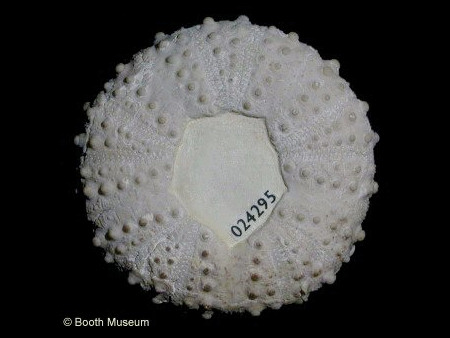
Here's another little treat we encountered on our walk at Sandia Peak. Look closely at the center of this picture. See a round thing protruding slightly from the rock face? I believe that is a marine fossil, probably some sort of ancient echinoid. You can see a similar example of a fossilized echinoid here for comparison. Cardgrrl took this picture while I held some branches out of the way to eliminate shadows on the object of our attention.
I'm sure that such fossils are a dime a dozen in the world of professional paleontologists. But I've never encountered one outside of a museum before. I have to say that it felt pretty cool to be wandering down a path and spot this critter that died tens of millions of years ago just sitting there, as if planted by a park ranger for the enjoyment of the hoi polloi who can't be bothered to do the hard work of digging up fossils.
It was very tempting to get some tools and chisel the thing out of the rock and take it home. But my guess is that they frown on that sort of behavior.
While hiking around Sandia Peak with Cardgrrl Tuesday, we both noticed this rather magnificent example of a tree root splitting a rock. Stepping back far enough to capture the whole thing in one photo would have meant falling off a precipice, and I don't have a wide-angle lens, so I resorted to my only remaining option: Take a bunch of overlapping shots, then have software stitch them together digitally.
What do you think of the result? (Right-click "open link in new tab" to see it full size.)
Busy weekend ahead. Tomorrow night Josie will be arriving in town, and I guess we're going out to a steak dinner somewhere. She claims--get this!--that I owe her this dinner because of losing to her at poker. Have you ever heard such a ridiculous thing in your life? She's obviously hallucinating, but I'm going along with it, because it can be dangerous to confront a psychotic person about his or her delusions.
Tomorrow is also reported to be the opening of the newest poker room in town, at Ellis Island casino. E.I. is one of the few non-pokery casinos that I've been in several times, because of its excellent barbecue restaurant. I hear that the room will be just two tables, so not exactly a tsunami hitting the local poker scene and overthrowing the big boys.
Saturday night is another allvegaspoker.com tournament, with no rake and free pizza, which on both counts clearly elevates it above that piddly ol' WSOP thing that's going on.
Then Sunday night is a private poker tournament for friends Tony Bigcharles and readers of his blog.
I'll let you know if any interesting and/or amusing stories result from any of the above.
Having a pleasant and productive time in New Mexico. Cardgrrl wanted to revisit Sandia Peak via the tram. We were there in February, 2010, my first time to Albuquerque, but mid-winter and mid-day. This time we went in time for a short hike to be followed by watching the sunset, which seems to be quite a popular activity around here, judging from the crowds and the cameras. It's a pretty nice view, not done justice by my little point-and-shoot Nikon. (Right-click "open picture in new tab" to see it full size.)
Just over 24 hours from now, I'll be flying to Albuquerque for a few days with Cardgrrl and her sister, who lives there. Will be back at the grind by next weekend, though.
Chris "Fox" Wallace, in Bluff magazine, June, 2012, page 71.
When aspiring pros find out that being a poker pro mostly involves folding hands and waiting for the right spot, they get bored. Sometimes it seems like you are folding hands all night long, and when you do get a hand, you end up folding the flop. And on a rough streak this can happen for a week straight. When an aspiring pro discovers that playing poker correctly really isn't that much fun and it isn't the fascinating creative experience he thought it would be, the bloom is off the rose. Playing poker for a living is a ton of work, and sometimes you work hard all week for a paycheck that has a negative number written on it.
After a few years as a pro, you may start to wonder when the big baller lifestyle is going to kick in. You'll get impatient for your time on TV at a big featured table, your time on the podium being awarded a bracelet, your big sponsorship dollars. And they may never come. There are great players who have never done any of these things. They just grind away, making good money, paying the mortgage, paying a ton of taxes, and folding hands. Are you sure that's what you want?
This article is really the long way to ask a simple question. Do you really want to play poker seriously, or do you want to play poker the same way I wanted to be an astronaut when I was 9?
Tonight was the first time I've made it over to the Rio since the WSOP began. I've been negligent.
Even during the Series, when I play there my usual choice is the poker room, not the convention center. One reason for that is that I get comps and Total Rewards points in the poker room, but not in the Pavilion Room. More importantly, though, is that I really hate playing in the Pavilion environment. There are tons of people milling around, it's freezing cold, the competing overhead announcements are deafening and distracting, etc. If there are poker tables in hell, I imagine the surroundings are about as unconducive to relaxed, thoughtful poker as the Pavilion Room. But I had reason to think that several people I'd like to connect with socially would be hanging around, and I wanted it to be easy for them to find me, so I sucked it up and played in the big hall.
Here are the hands I played.
(Hint: #7 is the interesting one, if you want to skip ahead to the good part.)
Hand #1
On the fourth hand I was dealt, I was in the cutoff seat with K-Q offsuit. There were a few limpers, so I raised to $13. Three callers. Flop A-10-J. Well, now, isn't THAT pretty? They all checked to me. I bet. They all folded, the last one while telling me, "You must have an ace." Good guess, but no.
Hand #2
AA. I raised, one caller. Some ragged flop, and my c-bet won it.
Hand #3
I had the Mighty Deuce-Four of Crubs in the big blind and called a raise to $8. Flop was 7-8-9 with two more crubs. I called a small c-bet from the raiser, as did one middle-position player. Turn was 3c. Ding! My plan for a check-raise was foiled when action checked around. River was an offsuit ace, I think. I bet about 2/3 pot and got called by the middle guy, original raiser folded. Deuce-Four wins. LDO.
Hand #4
On the button, I joined nearly a tableful of limpers with 5d-8d. The big blind was a tricky, aggressive player. He raised to $18. This looked to me like an attempt to pick up the pot without a fight, and was something he would likely do with any two cards. I decided that a limp-call here would look most like a small pair hunting for sets, and with position and a solid table image, there was a good chance I could torture him with hard decisions, and likely steal the pot. The flop was something raggedy, probably missing him, but it paired my 5. Odds were good that I now had the best hand, so when he checked to me, I read it as him giving up, bet, and won.
Hand #5
KK. Raised, won the blinds. Apparently I had instilled some fear into the hearts of my opponents. Which I don't mind one little bit.
Hand #6
This was the hand immediately after the last one--KK twice in a row! The table bully (he loved big pre-flop raises and reraises) raised to $18. If I reraised, it would be my first three-bet, which he would definitely notice, and he'd either fold or be able to narrow my range down so far that it would be very unlikely that he'd make a big mistake for a lot of money as the hand progressed. (This was especially true given what the immediately preceding hand had revealed about my image.) So, deviating from my usual play, I decided to just call him. I thought this would be a good spot for a one-big-pair call-down. I.e., as long as I didn't scare him off with aggression, I expected him to keep firing whether he improved or not, and I would just let him, since I was severely under-representing my hand. It was a risky way to play it, but I wanted to take a chance on bleeding him maximally. (As a side benefit, if an ace flopped and he looked as though he liked that, I could let it go with minimal damage.)
It didn't work out that way. The flop was 664. I was greatly surprised when he checked. I thought that would look to him like about as safe a flop to c-bet as he could ask for. I was a little puzzled, and decided to change course from passive to active and see what he did. I bet $25. He called. This made me think that he probably had a pocket pair higher than the board but below my kings, and he might keep paying out.
Turn: another 4. He checked. I bet $40. He called.
River: 2. (Oh to have the Mighty Deuce-Four now! It would give me the SuperFullHouse, fours full of both sixes and deuces!) He checked again, which allayed my small lingering fear that he had flopped trips or a boat and was trapping. I tried to guess the biggest amount that he would call with just a medium overpair, with him hoping that I was firing with just a big ace on this double-paired board. I settled on $50. He thought for maybe ten seconds, then called. He chortled when he saw the kings, and said, "That's very good." He mucked without showing.
My best guess is that I had pegged his hand correctly (something between 7s and 10s; with jacks or queens he would have led out on the flop, I believe), and my sneaky pre-flop call got me pretty close to squeezing as many chips out of him as he would ever have parted with. Hilarity ensued, in the form of him picking up his remaining chips and leaving without another word. This was the same guy I had beaten with Deuce-Four, and I guess he had had just about enough of me.
It appeared that now I had the table both scared and confused.
As Mr. Burns is fond of saying, "Excellent!"
Hand #7
This is the one that I think is the most interesting. The player on my right was a late 20s Asian male with a big stack. He was quiet and solid, aggressive, but not wildly so. In fact, I pegged him as the most dangerous player at the table, which is why I didn't do a seat change to one of my usual preferred spots when I could; I wanted him exactly where he was, to my immediate right.
His aggression was manifested by boldly playing for pots when any opponent showed weakness. If there was an orphan pot, he was the one most likely to go for it. He was smart and selective about his aggression. I had misread him several times already when I wasn't involved--thinking he was bluffing when he had the goods and vice-versa.
This hand was the only one in which we tangled for more than $10 or so.
I had A-K offsuit in late position, so raised to $13. A few limpers ran away, and he was the only one who stuck around for the flop. It was A-10-4 rainbow. He checked, I bet $20, he called.
Turn: 8. He checked. I checked.
This is not my usual play. In fact, it is exactly this deviation from my usual pound-pound-pound technique that, I think, is the interesting point. This guy was way too smart to pay off three streets with any hand that could not beat my top pair/top kicker. As soon as the flop hit, I knew that two streets of value was the most I could get from him, and even that was being optimistic.
So once he called the flop, my choices were (A) bet the turn and let the river go check-check, on the theory that he would only call a river bet with hands that beat me. Or (B), be more tricky about it, check the turn, and go for the value on the river.
The latter plan had this great advantage: He had never seen me take the betting lead, then relinquish it by checking. It had not happened even once in this session so far. He was plenty smart and attentive enough to recognize that a check on the turn from me was not how I had been playing. I thought that he would read it as weakness, and take a stab at the pot on the river. He would put me on something like K-Q that had whiffed, or a pocket pair that did not like seeing the ace flop.
The range of hands he could have with which he would bet the river after a check behind on the turn was far wider than the range with which he would call a bet from me on either the turn or river. It included all of his bluffing range plus a good chunk of his value-betting range. E.g., he could easily bet hands like J-T, Q-T, and K-T thinking he was best after I slowed down on the turn, but would never call a second bet from me with such a modest holding.
For that reason, I checked behind on fourth street. My primary purpose was deception--to induce either a bluff or what he would mistakenly view as a value bet on fifth street. It was a line that was tailor-made for this specific opponent's previously demonstrated tendencies, designed to get one more street of value from him with his nothing and one-pair hands than he would otherwise give me.
Therefore, when the river came a harmless-looking deuce, my decision was already pre-made to call when he did what was expected of him and bet $40.
Sadly, though, he had gotten lucky on me. He turned over 8-8 for the turned set.
I lost about $75 on the hand, but I actually felt really good about it. If you take all of the hands with which he would have taken the exact same line (limp-call, check-call, check, and bet), I think I beat far more of them at showdown than I lose to. Despite having lost, I think I played it as well as I possibly could have, given who I was up against.
As it turned out, my attempt to be deceptive worked out in my favor in a completely unexpected way: It saved me money by keeping the pot smaller, and prevented me from having to make a difficult decision if he had check-raised me on the turn.
More hands
I then won a little flurry of small pots that coincidentally got me back to within a couple of bucks of where I had been before that AK/88 hand. As it turned out, that one hand was the only one of the entire session that I lost after having put in any more money than the amount of the $3 big blind. After Hand #6, I had entertained a glimmer of hope that I might complete a whole session never losing a single pot to which I had contributed more than the big blind, which would be truly remarkable. I didn't quite pull it off, but I came awfully close.
I don't know if the blogger just made a simple error, or if this is a damnable lie intended to tarnish the good reputation of the Mighty Deuce-Four, but it is obviously not actually possible to bust out of a tournament while holding that hand.
I've had a mini streak of run-good lately. Upon entering my numbers for this evening's session at Binion's, I noticed that my results for June so far show me winning at the completely ridiculous and totally unsustainable rate of $138/hour.
I chatted with Cardgrrl when I got home, and she asked me to what I could attribute the upswing. I thought a second and replied, "Good cards and bad opponents."
By Jove, I may have just stumbled upon the great secret of winning poker.
It's a little hard to say this, because I'm not used to it yet, but I suppose that I'm a professional poker player. I moved to Vegas intending to get a job as a poker dealer, but while waiting to get hired, I spent the days playing poker instead of dealing it, and soon found that I was able to keep the bills paid. So I've just kept on doing it. I play Hold'em exclusively, usually no-limit, and most commonly $1-2 or $1-3, with occasional forays into $2-5 territory. I play tournaments on-line once in a while, but for some reason that I haven't entirely figured out, I'm much more successful playing at casinos than on the Internet, and much better at cash games than tournaments.
You can contact me via email: it's rakewell1 at yahoo dotdotdot com.


 Posts
Posts