Wednesday, July 04, 2012

A little lesson in law and politics for the Fourth of July

Warning: Zero poker content.


For a long time, I have wondered this: Suppose a U. S. president had as his highest poilitical priority reducing the federal deficit, but could not get Congress to agree with him. Could the president simply refuse to spend some significant percentage of the money that Congress allocated? E.g., the president has a cabinet meeting and tells the department heads that they are each ordered to spend, say, 5% less than Congress authorized for their departments, and if they didn't, he would fire them and replace them with people who would carry out this directive.

Can the president do that?

Well, as with many things, this turns out to be a lot more complicated than it might appear. I am looking into it today because several days ago while flipping through radio stations I caught a bit of conservative talk show host Mark Levin. I missed the context of why he brought this up, but he mentioned in passing that Richard Nixon had done exactly that, and Congress deemed it to be such an abuse of power that it was on the original list of proposed articles of impeachment, though in the end it was not included among the three articles the House of Representatives passed. I was floored. I had no idea.

So now that I'm home from visiting family in Utah, and have some free time, I decided to look into this more. I'm not going to try to make this a formal explanation, nor provide links to specific sources. (Unfortunately, most of the best sources would require me to go to the law library, and the question doesn't interest me that much.) Rather, this is just sharing the basic points that I have learned in the last few hours of reading. But the two most useful pieces of research I found online were these:


and


It seems that this question goes all the way back to Thomas Jefferson, and has caused occasional legal and political skirmishes between the executive and legislative branches ever since. Most have been settled by negotiation and compromise without much by way of long-term consequences.

But it really came to a head under Nixon. He claimed that he had to refuse to spend several billion dollars in order to avoid exceeding the national debt ceiling. Whether that is true or not is disputed. But he was obviously not in particularly good standing with Congress anyway, and this act of defiance was kind of the straw that broke the camel's back. In response, Congress passed the 1974 Impoundment Control Act. ("Impoundment" is the general term for the president not spending funds allocated by Congress, while "rescission" is the formal process of giving the money back to Congress.) Nixon signed it (which I don't understand, since he had claimed that impoundment was an intrinsic constitutional power of the president). As a result, if the president wants to not spend money authorized by Congress, he has to follow certain procedures, which include getting Congress to agree.

You might guess that this doesn't tend to work very well. Congress has ignored or refused most of the rescission requests that have been subsequently made. It is viewed as kind of a slap in the face. It's the president telling Congress, "You're trying to waste taxpayers' money, and I don't want to let you." Congress doesn't like that. Reagan was the only president who had a sufficiently amicable working relationship with Congress that he could get away with it most of the time he tried it. When his successor, George Bush, tried to get Congress to take back $8 billion in what he considered unnecessary spending, Congress agreed to just $2 billion of the request, but also simultaneously withdrew $22 billion of funding for items that Bush had deemed priorities. He got the message, and never tried to get permission for impoundment/rescission again.

What do the courts have to say about this? There has been only one Supreme Court case on the matter, Train v. City of New York (1975), but it was decided on the grounds of the specific language of the appropriation statute in dispute. Neither side raised constitutional, separation-of-powers arguments, so the court did not address them. Lower courts, however, have said that the executive branch does not possess the authority to refuse to spend legislatively appropriated funds. (I am intentionally glossing over the difference between funds that have been allocated and those that have been appropriated, as well as the differences in how appropriations occur depending on the kind of spending involved.)

The 1974 law actually requires the Comptroller General (i.e., the head of the GAO) to sue the president to force him to spend appropriated funds if he is refusing to do so and is not following the rescission procedures the law mandates. As far as I can tell, that has never happened. That would be one strange court case, to be sure.

The executive branch does have discretion to move funds around within any particular spending appropriation, to the extent that Congress has not specified program-by-program allocations. But the president cannot move funds between departments on his own authority.

So what would happen if a president decided to disregard the rescission procedures Congress mandated, and just not spend some significant percentage of allocated funds? Well, somebody would surely sue--the Comptroller, or somebody who was supposed to get the money and didn't, or maybe a Congressional committee with oversight responsibility for the affected department. I really have no good sense of what the Supreme Court would ultimately decide. In addition, maybe Congress would initiate impeachment proceedings, as they did for Nixon.

In any event, it would clearly be, as Mr. Obama seems to like to say these days, a BFD, and would likely turn into one of the most momentous constitutional showdowns in history. It seems unlikely to me that any president would take the matter that far, as it would alienate nearly every member of Congress and make it impossible for him to get anything else passed. I would probably try it if I were president, because I would care more about righting the disastrous fiscal course we're on than anything about what might happen to me personally or politically. But nobody who thinks like me would ever get elected, so it's kind of a moot point.

OK, children, that's your Fourth of July lesson in American history, politics, and law. Class dismissed. Go set off some firecrackers.

Tuesday, July 03, 2012

Roshambo-playing robot

Way cool. See here: http://goo.gl/2Qcu3


Hat tip: Pokerati.

Heading back to Vegas in the morning.

Tuesday, June 26, 2012

Kiva

My wonderful grrlfriend reminded me with her blog post today to check up on the status of the Kiva loan I made, since she was the one who prompted me to sign up in the first place. Kiva lets newly joining members make a $25 loan for free. It costs you absolutely nothing except a couple of minutes to fill out the membership form and pick a person to send the money to. Of course, the interest payments on this free money go back to Kiva rather than to you, but you get to help somebody climb out of poverty, and see how the whole system works.


I selected Porfiria, a woman in Bolivia who makes and sells hats, where there never were hats before, which seemed fitting. She wanted to buy a sewing machine so that she could make and sell more hats. According to her Kiva account status, she must be doing just that: She has timely made the first three of her ten scheduled installment payments. I can be a softy at times. When I chose Porfiria to receive the free $25 Kiva gave me to invest, I saw that it left just $25 more for her request to be complete, so I kicked in the last bit from my pocket. I already have $12.60 in credits due to her repayments. I think I'll let it run up to a nice even $25 before reinvesting it elsewhere.

Anyway, Kiva is a great organization. It allows some of the poorest people in the world to become less poor through good old-fashioned hard work and entrepreneurship. It's a cheap, painless, and rewarding way to make the world a better place.

Vanishing act

I'm going away again, this time to Salt Lake City for some family time. As John Denver famously sang, "Don't know when I'll be back again." Maybe a week, maybe more, maybe less. Events will dictate.

Annoying rule at Sandia

I forgot to tell you about an annoying rule I discovered playing last week at Sandia Casino in Albuquerque.


I was at a must-move table. After a few rounds, they called my name to move. I was in the small blind at the time. I assumed that I could stay one more hand and play my button. But no. The dealer said, "They've already called you for the must-move, so the button moves two spots." He wouldn't deal me in.

I asked, just to be sure: "You mean, even after paying both blinds, I can't stay one more hand for the button?"

He said, "No."

I said, "That's harsh."

He said, "Life is harsh."

I don't know of any other casino that is that strict on the timing of moving from a must-move table. As far as I can recall, when this has come up before, every other poker room I've been in has allowed the player to take the button before moving, after having paid both blinds.

Not a huge deal, obviously, but a small annoyance that they could so easily avoid.

Crazy hand at WSOP

If you're a poker rules nerd, you might enjoy these two separate write-ups of the nuttiest hand of WSOP 2012 so far:


(Note that in the first version, B.J. Nemeth makes a slight error by missing Shaun Deeb's flush, but the outcome is the same.)

Sunday, June 24, 2012

When to look at your cards?

Steve Zolotow, in his column for Card Player magazine, June 13, 2012, writes this (page 40):

I hope everyone avoids looking at their cards until it is their turn to act. There are two reasons for this. First, you can't reveal anything about your hand because you don't know it yet. Second, you can focus on your opponents and not on your cards.
I have, of course, heard this argument before--many times, in fact. When I was first learning about poker by watching television shows like World Poker Tour and Celebrity Poker Showdown, I specifically remember hearing both Phil Gordon and Annie Duke explain that looking at one's cards before it is one's turn is an amateurish mistake.

I disagree.

I understand perfectly well the arguments made in favor of waiting to look. But what advocates of this position usually omit, or perhaps do not grasp, is that there are countervailing arguments.

First, waiting to look until it's your turn means that the whole game runs more slowly. That is not a small consideration.

Second, to quote Phil Ivey, "If you have tells, work on them." If you're giving away information by body language or facial expressions when you check your hole cards, that's a problem you need to fix pronto. Whether you give off that information a few seconds after you get your cards or only when it's your turn makes little difference. You need to not be spewing such tells, period. Of course it is the case that your action (fold, call, or raise) will also be giving off information, but that is a separate matter. You don't want your face and body to be saying one thing and your bet a contradictory thing.

Third, if you wait to look until it's your turn, all eyes will be on you as you do so, because everybody is waiting for you to act. Thus, if you do have tells, the way to be sure they get maximal attention from opponents is to wait until everybody is watching you while you check your hole cards. On the other hand, if you do it when most other players are doing it--as they receive their last down card--they're all busy with their eyes elsewhere.

Fourth, if you wait until it's your turn, you're likely to give off information by how long it takes you to decide what to do after looking at your cards. Raise or not? If so, how much? Even if your face reveals nothing, the delay in action can suggest how complicated or difficult your decision is. I say let that decisional time pass while other things are going on.

I don't usually like appeals to authority in argument, but it is definitely not the case that all the best players in the world wait to look until it is their turn to act. These days we are getting more and more live broadcasts of late stages of big poker tournaments. Just watch--you'll see that there is a lot of variation on this point among the greats. Though T.J. Cloutier seems to be pretty much vanishing from the tournament scene now that he is, sadly, in the twilight of his life, I clearly remember him addressing this controversy in one of his books. He said that he likes to give a quick glance at his cards as soon as they arrive, then direct his attention at what how the other players are reacting to theirs. I agree with him. It takes literally one second or less, so you won't be missing much.

I like having my own cards in mind as I watch the other players act. Often my default decision about what to do changes. A completely crap hand becomes raiseworthy if I'm in late position and everybody has folded. Marginal hands like A-8 and Q-J can go from being planned raises to being folds if there is any action before it gets to me, or reraises if a raise comes from a habitually frisky player. And so forth. I would be stunned beyond belief if any of my opponents can read on my face these changes in my thinking as the action unfolds.

For what it's worth, I've noticed that Cardgrrl adopts a compromise position. She looks at her cards when the action is about two seats to her right. There is an argument to be made that this tactic incorporates some of the advantages of both of the more common approaches (looking immediately, or not until it's your turn). It's worth considering.

I don't mind that there are differences of opinion, preference, and style on this question. What bugs me, though, is how dogmatic many proponents of the Zolotow/Gordon/Duke position are about it--insisting that theirs is the only right way and any deviation from it is a clear error. I just don't buy it.

Saturday, June 23, 2012

Showing a hand

After seeing me play a big hand last night, Rob asked me to do a post explaining why I showed my cards when I didn't have to. This is it.


We were playing at Bally's. Short version of the story: I had suited Q-10 against an aggressive player's K-J. We both liked the K-J-9 flop, but I liked it a little better than he did. I bled him for about $105 before he cried uncle to my big check-raise on the turn. He showed his top two pair before folding, and in return I showed him my straight.

My default is not to show when it's not required, but that's not an unbreakable rule. See section 4 of this post for a brief rundown of various strategic ways of approaching the show/don't show question.

In this particular instance, there were two forces at work:

1. Social/informational. A couple of years ago I discussed the voluntary exchange of information that sometimes occurs at the conclusion of a hand that has not gone to showdown. This was such an occasion. If I don't at least occasionally reciprocate when another player initiates this kind of exchange, they will stop doing it, and I'll lose out on the information I gain from them voluntarily showing. I thought this guy was one of the most unpredictable players at the table, and I was happy to have a chance to mentally correlate how he had looked and acted during the hand with what he was holding.

2. Metagame. At that point in the proceedings, I was feeling that I was being called down a little more than I wanted to be, not being given enough credit for having a hand. This was a rational reaction for the table to take, given that I had been playing some marginal hands and had been pushing the trickiness a little more than usual. Showing the nuts was intended to regain some respect, so that I could resume using valuable tools such as the check-raise bluff and the light pre-flop three-bet. And I'm pleased to say that it worked. In the next half-hour or so, I picked up a few pots with aggression not supported by the cards I held.

So that's the answer. Not particularly brilliant, original, or exciting, but the truth.

Fossilman


(No, this is not a post about Greg Raymer.)

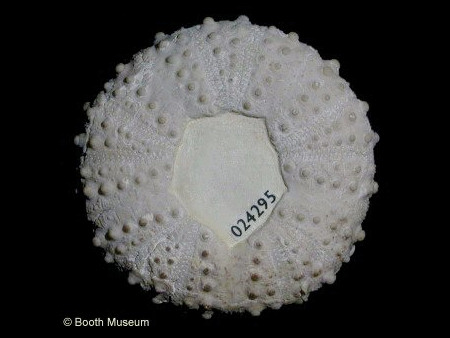
Here's another little treat we encountered on our walk at Sandia Peak. Look closely at the center of this picture. See a round thing protruding slightly from the rock face? I believe that is a marine fossil, probably some sort of ancient echinoid. You can see a similar example of a fossilized echinoid here for comparison. Cardgrrl took this picture while I held some branches out of the way to eliminate shadows on the object of our attention.

I'm sure that such fossils are a dime a dozen in the world of professional paleontologists. But I've never encountered one outside of a museum before. I have to say that it felt pretty cool to be wandering down a path and spot this critter that died tens of millions of years ago just sitting there, as if planted by a park ranger for the enjoyment of the hoi polloi who can't be bothered to do the hard work of digging up fossils.

It was very tempting to get some tools and chisel the thing out of the rock and take it home. But my guess is that they frown on that sort of behavior.

Splitting the rock


While hiking around Sandia Peak with Cardgrrl Tuesday, we both noticed this rather magnificent example of a tree root splitting a rock. Stepping back far enough to capture the whole thing in one photo would have meant falling off a precipice, and I don't have a wide-angle lens, so I resorted to my only remaining option: Take a bunch of overlapping shots, then have software stitch them together digitally.

What do you think of the result? (Right-click "open link in new tab" to see it full size.)

Friday, June 22, 2012

Busy weekend

Back from New Mexico.


Busy weekend ahead. Tomorrow night Josie will be arriving in town, and I guess we're going out to a steak dinner somewhere. She claims--get this!--that I owe her this dinner because of losing to her at poker. Have you ever heard such a ridiculous thing in your life? She's obviously hallucinating, but I'm going along with it, because it can be dangerous to confront a psychotic person about his or her delusions.

Tomorrow is also reported to be the opening of the newest poker room in town, at Ellis Island casino. E.I. is one of the few non-pokery casinos that I've been in several times, because of its excellent barbecue restaurant. I hear that the room will be just two tables, so not exactly a tsunami hitting the local poker scene and overthrowing the big boys.

Saturday night is another allvegaspoker.com tournament, with no rake and free pizza, which on both counts clearly elevates it above that piddly ol' WSOP thing that's going on.

Then Sunday night is a private poker tournament for friends Tony Bigcharles and readers of his blog.

I'll let you know if any interesting and/or amusing stories result from any of the above.

Wednesday, June 20, 2012

Sunset, Sandia Peak


Having a pleasant and productive time in New Mexico. Cardgrrl wanted to revisit Sandia Peak via the tram. We were there in February, 2010, my first time to Albuquerque, but mid-winter and mid-day. This time we went in time for a short hike to be followed by watching the sunset, which seems to be quite a popular activity around here, judging from the crowds and the cameras. It's a pretty nice view, not done justice by my little point-and-shoot Nikon. (Right-click "open picture in new tab" to see it full size.)

Back in a couple of days.

Sunday, June 17, 2012

Away again

Just over 24 hours from now, I'll be flying to Albuquerque for a few days with Cardgrrl and her sister, who lives there. Will be back at the grind by next weekend, though.

Poker gems, #457

Chris "Fox" Wallace, in Bluff magazine, June, 2012, page 71.


When aspiring pros find out that being a poker pro mostly involves folding hands and waiting for the right spot, they get bored. Sometimes it seems like you are folding hands all night long, and when you do get a hand, you end up folding the flop. And on a rough streak this can happen for a week straight. When an aspiring pro discovers that playing poker correctly really isn't that much fun and it isn't the fascinating creative experience he thought it would be, the bloom is off the rose. Playing poker for a living is a ton of work, and sometimes you work hard all week for a paycheck that has a negative number written on it.

After a few years as a pro, you may start to wonder when the big baller lifestyle is going to kick in. You'll get impatient for your time on TV at a big featured table, your time on the podium being awarded a bracelet, your big sponsorship dollars. And they may never come. There are great players who have never done any of these things. They just grind away, making good money, paying the mortgage, paying a ton of taxes, and folding hands. Are you sure that's what you want?

This article is really the long way to ask a simple question. Do you really want to play poker seriously, or do you want to play poker the same way I wanted to be an astronaut when I was 9?

Saturday, June 16, 2012

Rio session

Tonight was the first time I've made it over to the Rio since the WSOP began. I've been negligent.


Even during the Series, when I play there my usual choice is the poker room, not the convention center. One reason for that is that I get comps and Total Rewards points in the poker room, but not in the Pavilion Room. More importantly, though, is that I really hate playing in the Pavilion environment. There are tons of people milling around, it's freezing cold, the competing overhead announcements are deafening and distracting, etc. If there are poker tables in hell, I imagine the surroundings are about as unconducive to relaxed, thoughtful poker as the Pavilion Room. But I had reason to think that several people I'd like to connect with socially would be hanging around, and I wanted it to be easy for them to find me, so I sucked it up and played in the big hall.

Here are the hands I played.

(Hint: #7 is the interesting one, if you want to skip ahead to the good part.)

Hand #1

On the fourth hand I was dealt, I was in the cutoff seat with K-Q offsuit. There were a few limpers, so I raised to $13. Three callers. Flop A-10-J. Well, now, isn't THAT pretty? They all checked to me. I bet. They all folded, the last one while telling me, "You must have an ace." Good guess, but no.

Hand #2

AA. I raised, one caller. Some ragged flop, and my c-bet won it.

Hand #3

I had the Mighty Deuce-Four of Crubs in the big blind and called a raise to $8. Flop was 7-8-9 with two more crubs. I called a small c-bet from the raiser, as did one middle-position player. Turn was 3c. Ding! My plan for a check-raise was foiled when action checked around. River was an offsuit ace, I think. I bet about 2/3 pot and got called by the middle guy, original raiser folded. Deuce-Four wins. LDO.

Hand #4

On the button, I joined nearly a tableful of limpers with 5d-8d. The big blind was a tricky, aggressive player. He raised to $18. This looked to me like an attempt to pick up the pot without a fight, and was something he would likely do with any two cards. I decided that a limp-call here would look most like a small pair hunting for sets, and with position and a solid table image, there was a good chance I could torture him with hard decisions, and likely steal the pot. The flop was something raggedy, probably missing him, but it paired my 5. Odds were good that I now had the best hand, so when he checked to me, I read it as him giving up, bet, and won.

Hand #5

KK. Raised, won the blinds. Apparently I had instilled some fear into the hearts of my opponents. Which I don't mind one little bit.

Hand #6

This was the hand immediately after the last one--KK twice in a row! The table bully (he loved big pre-flop raises and reraises) raised to $18. If I reraised, it would be my first three-bet, which he would definitely notice, and he'd either fold or be able to narrow my range down so far that it would be very unlikely that he'd make a big mistake for a lot of money as the hand progressed. (This was especially true given what the immediately preceding hand had revealed about my image.) So, deviating from my usual play, I decided to just call him. I thought this would be a good spot for a one-big-pair call-down. I.e., as long as I didn't scare him off with aggression, I expected him to keep firing whether he improved or not, and I would just let him, since I was severely under-representing my hand. It was a risky way to play it, but I wanted to take a chance on bleeding him maximally. (As a side benefit, if an ace flopped and he looked as though he liked that, I could let it go with minimal damage.)

It didn't work out that way. The flop was 664. I was greatly surprised when he checked. I thought that would look to him like about as safe a flop to c-bet as he could ask for. I was a little puzzled, and decided to change course from passive to active and see what he did. I bet $25. He called. This made me think that he probably had a pocket pair higher than the board but below my kings, and he might keep paying out.

Turn: another 4. He checked. I bet $40. He called.

River: 2. (Oh to have the Mighty Deuce-Four now! It would give me the SuperFullHouse, fours full of both sixes and deuces!) He checked again, which allayed my small lingering fear that he had flopped trips or a boat and was trapping. I tried to guess the biggest amount that he would call with just a medium overpair, with him hoping that I was firing with just a big ace on this double-paired board. I settled on $50. He thought for maybe ten seconds, then called. He chortled when he saw the kings, and said, "That's very good." He mucked without showing.

My best guess is that I had pegged his hand correctly (something between 7s and 10s; with jacks or queens he would have led out on the flop, I believe), and my sneaky pre-flop call got me pretty close to squeezing as many chips out of him as he would ever have parted with. Hilarity ensued, in the form of him picking up his remaining chips and leaving without another word. This was the same guy I had beaten with Deuce-Four, and I guess he had had just about enough of me.

It appeared that now I had the table both scared and confused.

As Mr. Burns is fond of saying, "Excellent!"


Hand #7

This is the one that I think is the most interesting. The player on my right was a late 20s Asian male with a big stack. He was quiet and solid, aggressive, but not wildly so. In fact, I pegged him as the most dangerous player at the table, which is why I didn't do a seat change to one of my usual preferred spots when I could; I wanted him exactly where he was, to my immediate right.

His aggression was manifested by boldly playing for pots when any opponent showed weakness. If there was an orphan pot, he was the one most likely to go for it. He was smart and selective about his aggression. I had misread him several times already when I wasn't involved--thinking he was bluffing when he had the goods and vice-versa.

This hand was the only one in which we tangled for more than $10 or so.

I had A-K offsuit in late position, so raised to $13. A few limpers ran away, and he was the only one who stuck around for the flop. It was A-10-4 rainbow. He checked, I bet $20, he called.

Turn: 8. He checked. I checked.

This is not my usual play. In fact, it is exactly this deviation from my usual pound-pound-pound technique that, I think, is the interesting point. This guy was way too smart to pay off three streets with any hand that could not beat my top pair/top kicker. As soon as the flop hit, I knew that two streets of value was the most I could get from him, and even that was being optimistic.

So once he called the flop, my choices were (A) bet the turn and let the river go check-check, on the theory that he would only call a river bet with hands that beat me. Or (B), be more tricky about it, check the turn, and go for the value on the river.

The latter plan had this great advantage: He had never seen me take the betting lead, then relinquish it by checking. It had not happened even once in this session so far. He was plenty smart and attentive enough to recognize that a check on the turn from me was not how I had been playing. I thought that he would read it as weakness, and take a stab at the pot on the river. He would put me on something like K-Q that had whiffed, or a pocket pair that did not like seeing the ace flop.

The range of hands he could have with which he would bet the river after a check behind on the turn was far wider than the range with which he would call a bet from me on either the turn or river. It included all of his bluffing range plus a good chunk of his value-betting range. E.g., he could easily bet hands like J-T, Q-T, and K-T thinking he was best after I slowed down on the turn, but would never call a second bet from me with such a modest holding.

For that reason, I checked behind on fourth street. My primary purpose was deception--to induce either a bluff or what he would mistakenly view as a value bet on fifth street. It was a line that was tailor-made for this specific opponent's previously demonstrated tendencies, designed to get one more street of value from him with his nothing and one-pair hands than he would otherwise give me.

Therefore, when the river came a harmless-looking deuce, my decision was already pre-made to call when he did what was expected of him and bet $40.

Sadly, though, he had gotten lucky on me. He turned over 8-8 for the turned set.

I lost about $75 on the hand, but I actually felt really good about it. If you take all of the hands with which he would have taken the exact same line (limp-call, check-call, check, and bet), I think I beat far more of them at showdown than I lose to. Despite having lost, I think I played it as well as I possibly could have, given who I was up against.

As it turned out, my attempt to be deceptive worked out in my favor in a completely unexpected way: It saved me money by keeping the pot smaller, and prevented me from having to make a difficult decision if he had check-raised me on the turn.

More hands

I then won a little flurry of small pots that coincidentally got me back to within a couple of bucks of where I had been before that AK/88 hand. As it turned out, that one hand was the only one of the entire session that I lost after having put in any more money than the amount of the $3 big blind. After Hand #6, I had entertained a glimmer of hope that I might complete a whole session never losing a single pot to which I had contributed more than the big blind, which would be truly remarkable. I didn't quite pull it off, but I came awfully close.

Thursday, June 14, 2012

Yeah, I am one bad mofo at these free games!


That's two winner-take-all tournaments I've notched up in two days.

Where's my bracelet?

Wednesday, June 13, 2012

Winner take all? That would be me.


Shamus is now doing occasional home games on Stars. I took this one.

Ya gotta build that play-money bankroll with small events like this if you're gonna survive in this game long-term.

Tuesday, June 12, 2012

Can't possibly be true

An alert reader tipped me off to this piece of so-called poker journalism from PokerNews reporting the WSOP:


I don't know if the blogger just made a simple error, or if this is a damnable lie intended to tarnish the good reputation of the Mighty Deuce-Four, but it is obviously not actually possible to bust out of a tournament while holding that hand.

Monday, June 11, 2012

The secret

I've had a mini streak of run-good lately. Upon entering my numbers for this evening's session at Binion's, I noticed that my results for June so far show me winning at the completely ridiculous and totally unsustainable rate of $138/hour.


I chatted with Cardgrrl when I got home, and she asked me to what I could attribute the upswing. I thought a second and replied, "Good cards and bad opponents."

By Jove, I may have just stumbled upon the great secret of winning poker.

Sunday, June 10, 2012

An unsolicited advertisement (no poker content)

About ten years ago, while I was still living in Minnesota, there came a time when I needed to hook both a Mac and a PC to my home cable internet connection. I needed a router. I kind of randomly chose one made by Belkin. I was having a devil of a time getting everything to work together correctly. (There are, by actual count, 14 billion menus and submenus in the Windows operating system just for connectivity.) Putting my male ego aside, I finally called Belkin's customer service line for assistance. The guy on the other end was wonderful. Of course he had a prepared algorithm he was working from, but it was also clear that he understood what each step did, and could improvise as needed. He was smart, friendly, and infinitely patient. It took nearly an hour on the phone to diagnose and fix the problems, but then it was done, and the router never gave a speck of trouble thereafter.


That experience was so good that I made this one of my life's pre-made decisions: If something I need is made by both Belkin and other companies, I'll buy the Belkin.* I now have half a dozen Belkin doodads, and they have all performed flawlessly. None of them has died yet, despite years of constant use.

(Let us pause to reflect on the awesome power of one experience with a company's customer service department. If good, it can win brand loyalty for life, as Belkin did with me. If negative, it can engender a foul, "never again" blood oath, the bitterness of which lingers even beyond the grave. Either way, the experience gets shared with countless friends and/or blog readers. Yet many companies seem to try to keep customer service cheap by making it so intolerably unusable that nobody really bothers with it. Penny wise, pound foolish.)

My new computer is great, but it presented me with a niggling little problem: The USB ports are near the back, instead of near the front, as on my old computer. As you can see below, this means that I couldn't push it all the way back to the wall, because the USB cable ran into the speaker. (This photo makes it look like I could just use one of the other USB ports, but the depth is such that they all cause the same problem.)


I thought, "I wish somebody made a right-angle USB connector." Which was immediately followed by, "Hey, maybe somebody does." Google quickly told me that not only do such things exist, but that one of them is made by Belkin!

Amazon.com to the rescue, and yesterday the clever little gizmo showed up in my mailbox:


It has two separate axes of rotation, so you can make it fit just about anywhere. It feels amazingly sturdy for something so flexible.

And for about $8, the problem is solved:


(OK, to be honest, the problem is not quite solved. This Dell has its power cord sticking straight out the back, which limits how close to the wall I can get it. But I found another company that makes a right-angle adapter for that issue, and I expect it to arrive tomorrow. Then life will be perfect again.)


* I have one exception: I had my Adesso keyboard before the Belkin experience, and I love it so much, and so fear that they won't have the same model still available when this ten-year-old one finally dies, that five years ago I bought a replacement, and have it stashed in the closet for when that sad day comes. Belkin makes fine keyboards, I'm sure, but they can take my Adesso when they pry it from my cold, dead hands.

Saturday, June 09, 2012

Steve Zolotow is a fool!

Steve Zolotow's column in the May 30 issue of Card Player magazine is about becoming a tricky player, one who is difficult to read. His point is that you have to play different starting hands the same way as each other, and also play the same starting hand different ways at different times.


For his first example, he takes A-A and discusses the default play (reraise) plus some alternatives. He then does the same for suited K-J, medium suited connectors, and a small pair--in each case mentioning the default play plus how they should sometimes be played as if the cards are something else, like A-A.

Fine so far.

But then he screws up. For his last example, he uses 4s-2h. Yes, the Mighty Deuce-Four. Of this he says, "With 4-2 offsuit, your default play is to fold. But occasionally you can raise as a pure squeeze play, hoping everyone folds. If you get re-raised, it is an easy fold."

The man does not know whereof he speaks. He is clearly unqualified to be writing a poker column. I demand that he be fired at once!

However, he does mention something I had not heard before, which he says is "an old pun": When one wins with the 4-2, one can say, "It was a fortuitous hand."

Get it?

Four-two-itous.

That's one way to play it

Here's a strange hand from the Merge Network daily HORSE tournament that I just played. This is 7-card stud. Imagine the lower window directly to the right of the upper one, to read the hand history:


On 3rd street, my opponent calls the 15 bring-in, then calls my completion to 60. He's in for 65 (including his ante), and the pot is 170. On 4th street I pair my queen, so I make the optional double bet of 120. He calls. He's in for 185, and the pot is 410. 5th street looks safe, so I bet again, he calls again. He's in for 305, and the pot is 650. I don't like him pairing on 6th street, because he may well now have two pair, but in for a penny, etc. I bet again, he calls again. He is now in for 425, and the pot is 890. On 7th street, I bet once more, and he folds.

Now, this might not seem too unremarkable, except for one crucial fact that the hand history does not contain: He started this hand with 440 chips. He spent 425 of them--97% of his stack--then folded, getting a rather incredible 60:1 pot odds for calling with his last 15 chips on 7th street.

Of course, one of the good things about 7-card stud is that in some instances you can be absolutely certain that such a fold is correct, because if you can't even beat what your opponent has showing, it's impossible to win the hand, and it doesn't matter what his three down cards are. But if that's the situation you're going to be faced with, it's far, far better to put in your last chips on 5th or 6th street when you still have a shot at winning than it is to leave yourself with one quarter of one small bet when you know you've lost. He should have either folded earlier, or tried to put all his chips in earlier.

Last year I wrote about seeing a guy fold the river when getting 20:1 on a call. But I'm not sure I've ever seen a 60:1 fold before.

Solution to the Merge hand-history problem

Today I hit upon what perhaps should have been an obvious solution to the problem of Merge Network software update making it harder to get to the hand histories: You can just open the history window after the first hand, then click "next" to move forward in time. You could do that after each hand, or just when you're interested in what happened on the previous hand. I forward it up to the last hand when I'm not doing anything else and happen to think about it so there's less clicking to do when the time comes that I want to check the previous hand.


I suppose that overall it might make for more clicks, but they're all in the same spot, and not in a window that pops up behind the game window, as happens when you click on the hand number on the active table.

That's the hand-history window peeking out from behind the game table on the lower right:


Bovada sucks

I just tried using Bovada (aka Bodog) for the first time since the name change. They had given me a free ticket to a $75 WSOP Main Event satellite (actually a satellite to a satellite, but whatever). OK, it wasn't just a name change; Bodog per se still exists, but no longer operates in the U.S., instead leasing its software to another company that offers games here. The software underwent a major overhaul at about the same time as the market/company change.

How do I hate it? Let me count the ways.

First, I tried changing the background color to red, then to green. It wouldn't do it. Those options were clearly shown, and I clicked on them, but the background stubbornly stayed blue. If you can't actually change it, why do they show it as an option that you can?

Second, at seemingly random intervals, the software would not obey my pre-selected action. Below, for example, you can see that I have elected to fold my 7-2 while the action is still three players to my right.


But when it's actually my turn, the software acts as if I had not made any selection, and waits for me to tell it what to do:


Mind you, this doesn't happen every time--just once in a while, for no obvious reason. After I recognized it as happening enough not to be just a one-time fluke, I started doing a screen capture every hand just to catch it with these before-and-after shots, and it behaved correctly four times before giving me the opportunity you see above. Why? I have no idea.

Third, the anonymity is terribly annoying--much harder to keep track of players mentally as they move in and out of the table.

Fourth, you are no longer given the option of a preferred position at the table. (For those of you who don't play online, this doesn't mean that you can actually choose which opponents are on your right or left; it's just a virtual rotation of the table so that you see yourself in the same screen location every game.) I like being at the bottom of the screen, and it won't let me choose that, at least not with anything I could find.

Fifth, you can't selectively turn the sounds on or off--you either get all of them or none of them. If you want a little "ping" when it's your turn and a more insistent warning when you're running out of time, fine, you can have them--but you also have to accept the cacophony of other sounds: cards being dealt, chips sliding across the table, etc.

Sixth, when it was my turn, the amount of the current bet was highlighted, as you can see toward the bottom right of the second screen capture above. I should be able to either just type a different amount to bet/raise, or first erase the amount shown with the backspace key, then type in an amount. Sometimes I could do this, sometimes not. On the "not" occasions, it just ignored my keystrokes--and that was the same whether I was using the laptop's built-in keyboard or the full-sized external keyboard (connected via USB) that I use when I have serious typing to do. As with ignoring pre-selected actions, this appeared to be completely random.

On those occasions when I couldn't use the numeric keyboard to enter a bet amount, I had to use the slider. I HATE using bet sliders generally, and this particular one is especially awful. It's way too sensitive (i.e., small movements change the bet by a large amount), and it doesn't stop at pre-specified intervals. If I wanted to raise to, say, 100, I'd have to settle for 108 or 93 or whatever other odd amount in that general vicinity the slider offered me. Trying to nudge it just a wee bit more one direction or the other would result in it being much higher or lower than I wanted, or my turn timing out. The only fixed options available with dedicated buttons are 1/2 pot and pot. I most commonly want to bet somewhere between those two choices, something like 2/3 to 3/4 pot. Good luck with that on this platform.

Seventh, the "spotlight" feature is not nearly as prominent as it used to be. This had previously been one of Bodog's better touches: The player with current action had a virtual spotlight shone on him to indicate whose turn it was. Of all of the online poker platforms I have used, I found this one by far the easiest to follow, in terms of being able to tell at a glance where the action was. Now that light has been turned down so much that you have to go searching for it. You can see what I mean in the second photo above. You just see sort of a half-assed half-circle of slightly lighter blue below my spot. (By the way, I'm player #1 solely by virtue of having been the first to register for this event.)

Those of us who have been using computers for a couple of decades know that there is a long history of software companies rolling out a grand "upgrade," only to be met with howls of protest from users about how they screwed up everything that had been good about it. Twitter recently did that with TweetDeck when they bought it and issued a new version. (I found a way to install the last good version--v0.38.2--with all of the flexibility it had due to using Adobe AIR, on my new computer, and have embedded deeply in my brain a stern reminder to always decline offers to install any newer version, at least until I'm sure they have restored all of the options they killed off in the "improvement.") Bit.ly seems to be the latest victim of this. I used to use it as my URL-shortening utility, but it no longer works as easily as it did before, instead requiring me to make a bunch of choices I'm not interested it. As a result, it is now dead to me; I removed it from my old computer the day they screwed it up, and I'm certainly not adding it to the new machine. From what I've read of Windows 8, Microsoft may be on the verge of surpassing all of these, and making the most monumental "New Coke" blunder in the history of software.

To this list must surely be added the "new and improved" Bodog/Bovada. You can read the press release, bubbling over with giddy anticipation, here. A "huge leap forward" they said. Yeah, sure it was--a leap right off of a cliff, if you ask me.

After we lost PokerStars and Full Tilt Poker, Bodog was far and away my favorite of the platforms that remained usable in the states, both in terms of ease of making money and in terms of how the software functioned (with the exception of hand histories). But the "upgrade"? It's hard to be more succinct, accurate, or forceful than I was in my title above: Bovada sucks.

Friday, June 08, 2012

Ask and ye shall receive

Two readers kindly offered to send me the non-US PokerStars setup file. I just received and ran it, worked like a charm. I jumped into a play-money SNG, and it had my avatar loaded up, remembered my seating preference, and allowed me to run the animated hand history viewer, just like old times. The main lobby even shows me the real-money games, though obviously I have no money on account, and can't load any, so it's like showing a chocolate layer cake to a starving man.


So that's the solution--get a foreign friend to share the setup file with you. It won't get you back into the real games, but at least it restores full functionality to the software for your free games.

Thursday, June 07, 2012

Maybe too many people know about the Deuce-Four

I'm supposed to win hands like this, not chop the pot, dammit!


How can double deuce-four not be the winner?

See the story and photo from the Pokerati blog:


I have seen a fouled deck exactly one time, and it wasn't nearly that dramatic. I was playing a tournament at Caesars. They were using WSOP-backed cards. They alternated between two decks with the dealer changes. The decks' backs were identical except that one had a very thin black line around the border, the other an equally thin red line.

We had been playing for a couple of hours at the table when I noticed that my two down cards were one with a red border and one with a black border. I pointed it out to the dealer, who called the floor. It was a fouled deck. But nobody had taken any action, so it was trivially easy to fix. They took the decks away for inspection. I don't know what they found. Maybe there was an extra card. Maybe one card from each deck got into the other. But we had played with those cards for two hours or so without anybody noticing anything amiss.

Lesson: If you're going to have two decks in action at a table, they should be extremely easy to distinguish at a glance.

Workaround?

Of course U.S. residents have not been able to play real-money games on PokerStars since Black Friday. But those of us who had had Stars accounts could at least keep playing the free games with the full software, whereas if you download the client software from Pokerstars.net, you get a watered down version. The two features most sorely lacking are the ability to select your own seat and the ability to immediately check the previous hand history. There was some sort of grandfather provision, that if you had had a real-money account prior to Black Friday, you got software updates that prevented you from playing real-money games, but at least kept the full functionality intact.


I've moved everything to my new computer over the last eight days. But the Stars problem is still frustrating me. I have downloaded the .net app, and it recognizes me from my old Stars account, but I'd really rather keep using the .com (or .eu) version, as I had been able to do on the old computer.

I cleverly thought that I could move the setup (.exe) file from the old computer to the new via thumb drive, then run that on the new computer, and it would install the .com software, which would then automatically update next time I logged on. Nope. New computer wouldn't run the setup file--something about the certificate being out of date.

Tech-heads: Is there some way to get my new computer to be able to run the old software the same way that I could with the old computer?

Wednesday, June 06, 2012

Merge Network is having, um, issues

As I noted yesterday, Merge did a full revamp of their software Monday night. It took many more hours than they had promised, and even when they were up again, they immediately had problems. I, for one, couldn't display the main lobby correctly. My friend Stacey couldn't even log in.


This morning my buddy Shamus ran into problems using Hero Poker, one of the Merge skins. He tweeted:
Merge is so very screwed up right now. Here's how my SNG is going... we're in Level 6 http://t.co/H5jFvakg @heropoker @carbonpoker

The good news is after a half-hour I am leading the SNG currently, with none of us having played a hand. @heropoker @carbonpoker

Erm, I just went from 1st to last. Somebody is playing my stack. What applesauce. @heropoker @carbonpoker

SNG finally shut down... says $ refunded. All at cash tables complaining about various applesauce. Whatta mess. @heropoker @carbonpoker
In spite of that, Josie and I decided, perhaps foolishly, to try to play Merge's daily $11 HORSE tournament. She will be in town in a couple of weeks, and there will likely be some mixed-game shenanigans at some point, so she needs more practice with games other than hold'em.

My table was going fine, in technical terms. Josie's wasn't. It was slow as molasses, and it looked to be more of a software or server problem than anything that could be blamed on the players. E.g., hands would take forever to clear off the table after the pot was awarded.

She started out strong, while I started out with everything going wrong. So of course she offered a last-longer bet when she was already up 1875 to my 1341. I accepted it, because, apparently, I'm a sick, degenerate gambler.

Then she watched in horror as I mounted a comeback. I rivered a ace-high flush (crubs, obv) in a five-way pot in stud/8 when nobody had a low, and scooped a monster. This was followed immediately by making a wheel on 5th and scoring a double elimination super-scooper-dooper. Those two hands propelled me well above Josie's stack, and she was trembling in fear:


But then--disaster:


WTF?

A few minutes later, this email showed up in my inbox:


As Shamus says, applesauce.

We thought about trying another SNG, but while browsing for one, it looked like they were in the process of shutting everything down. There were very few games with "registering" status. My guess is that right about now they're offline completely, or about to be.

While I'm complaining about their software bugs, I might as well also complain about some features of the new redesign. They have a few nice improvements, such as a double slider for setting the upper and lower limits of buy-ins for tournaments that you're interested in playing. But they also made it harder to find some customization features. And what used to be a one-button click to see the previous hand is now completely hidden. Josie pointed it out to me. You click on the tournament number in the upper left-hand corner of the game--which is not marked in any way as having this function until you mouse over it--and it brings up a cascade of folders from your hard drive where the hand histories are stored:


(Note that they even got the date wrong. Josie checked, and hers correctly showed 6/6/12. No, there is nothing wrong with the date and time settings on my computer. No, I have no idea why it would be right for one player and wrong for another.)

If you click on any hand number, up pops that hand history, in the same format as they have always used. But it takes a lot more work, time, and thought to get at it than it used to. This is an improvement?

They really screwed the pooch on this software "upgrade."

Lock in the news

That thing I was saying yesterday about Lock Poker having a string of suspicious-looking conduct? Well, check out this story from today's poker news:


Be careful. It's a jungle out there.

Let them eat Cake

Last October I reviewed the status of the U.S.-facing online poker networks. Quite a bit has changed since then.


Bodog is now Bovada. I have installed the new software, and confirmed that they carried my balance over, but have not yet played there. I'm not thrilled about the anonymous table innovation. But I'm sure one of these days I'll see what it's like.

The Merge network is still going strong. After running through the initial $100 deposit I had made on the Black Chip Poker skin, I didn't do any more with it for a few months. Then Josie announced that she was going to restart her Very Josie poker series there (which didn't last long, because the site had stupid restrictions that severely cut into the fun factor), and Tony was frequently tweeting and blogging about winning money there. So I decided to give it another chance.

Unfortunately, I couldn't make a deposit. I tried all of my credit and debit cards (including a Visa gift card I purchased just for that purpose), and all were rejected, even though I had used one of them to make my first deposit without any problem. My guess is that this was a policy change with the credit card issuers, not with the site, because the site continues to list Visa cards as a method of deposit, even for U.S. players. But Tony's credit card still works to deposit there, and he was kind enough to let me give him cash to make a deposit and then transfer the credit to me, which worked just fine. I've been playing there more lately, and making a little profit at it. I started with $200, and I'm playing in sufficient small amounts that it would take a pretty severe downswing for me to need to deposit again.

The Everleaf network withdrew from the U.S. market in February this year. I still had about $79 sitting on the Luvin Poker site. They had given me fits trying to withdraw it, and I had basically given up, when that announcement came. They promised that deposited funds were safe, and they were going to get us our money back real soon. But it's been four months, and there has been no further word. I wrote to Luvin's customer support a few days ago, and got what basically amounts to a bedbug letter:
I see you have around 56 Euros on LP (they converted the US dollars). The money is still in your account and funds have not ben seized. ELG is working with the Maltese Gaming Commission trying to find a way to release funds. Due to the law in the US, every method they have inquired about has been shot down, including player to player transfer to our friends who can cash out. The Gaming authorities feel it would essentially be money laundering if we were to process these funds. We are even looking at hiring a mediator to retrieve funds. Again, this does you no good, but if you log into your account you will see funds there. They assure me monies are safe and I do believe that, but unfortunately no further news on how to retrieve them. Currently players who have bank accounts off shore are allowed to cash out and they are looking for alternatives. I am saving your Email, so I will be sure to update you if anything changes.

LP truly hopes to have a place in the future once legislation comes through. Although this does not solve the problem, please know our brand reputation is very important to me and if at all possible, those funds will be returned.

My sincere apologies.
As the saying goes, I'm not holding my breath.

The Yatahay network has some of my money, as mentioned in the October post, due to the skin called "America's Cardroom" taking over what had been the "Doyle's Room" accounts, when Doyle decided that he didn't want anything to do with online poker anymore. I played one $5 SNG the other day on my new computer just to make sure that the software was working, balance still there, etc. I don't know what, if anything, I'll do with the $200+ that I have sitting there.

The network, incidentally, has taken on a new name. It's now the "Winning Poker Network." Admittedly, "Yatahay" was a terrible name, but the new one is just as bad, although for different reasons.

Finally, there is the Cake network. Recently, Lock Poker, which was one of the biggest skins on the Merge network, left Merge and joined Cake. Or perhaps it's more accurate to say that they took over Cake, and in the process have changed the name to the Revolution Gaming Network. (Read more about the whole deal here.)

I got a Cake account when it first came on the market, but I think I just played a few free games to test it out and never put any money there. Essentially all of my play on the Cake network was when Doyle's Room was one of their skins, before DR moved to Yatahay. (Yes, it's all very confusing--like a corporate soap opera.) I haven't wanted to do more with it because of recurring stories of what sound to me like shady goings-on at Lock, and persistent problems reported for U.S. players getting timely cashouts from Cake.

But yesterday my friend Stacey, who has been a much more serious online player than I, tweeted that she had played a few low-stakes tournaments on the new Lock site: "Verdict thus far: @lockpoker software is meh but players are terrible, decent schedule, a lot of it copies the Merge schedule so, not bad!" Then, a little later, "Ok the new @lockpoker is earning MAJOR points w/ me. Sent account verification docs to them less than 3 hrs ago. Already approved by support."

This made me think that maybe I should give the network another try. I knew I already had an account on the Cake skin (i.e., what had previously been the flagship skin), so rather than go through creating a new account with Lock, I just downloaded the new Cake software and reactivated that account. The cashier page said that they accepted Visa for deposits, and that debit cards tended to have better success rates than credit cards, so I used my U.S. Bank Visa check card, crossed my fingers, and *ding* about 60 seconds later I had $100 of credit on the site, with no fees deducted. So far so good.

I signed up for a $7 SNG just to try it out. Here's what it looks like:


It has annoying sound effects, but you can turn them off. They don't make it easy to find options and settings, but I eventually discovered how to shift the seats around to my preferred orientation, turn on the four-color deck feature, and other tweaks.

Good Lord, were these players ever terribad! In one fairly early hand, I had Q-3 offsuit in the small blind. Nobody raised, so I limped in with the rest. Flop was Q-4-3. I meant to lead out with a bet of about 3/4 of the pot, but accidentally clicked the wrong button and went all in. That shove was for about ten times the pot. Oops! Oh well, I thought--I'll pick up the limpers' chips and that will be the end of it. But no--I got a caller, "NanasVice," who had me covered. She had Q-J, for top pair with mediocre kicker, and I doubled up. I saw players with 7 BB stacks limp in, then fold to a raise. I saw one spew off a stack of 30 big blinds calling a flop shove in a limped pot with just a gutshot and backdoor flush draw. Horrible, horrible, horrible.

I was doing some other work while I played, so only giving it half attention, and still cruised into second place money.

And you'll be glad to know that the Mighty Deuce-Four works just as well on Cake as it does everywhere else:


I am still cautious and skeptical about the reliability of this new entity, as it combines a network chronically problematic in terms of cashing out (Cake) with a site that has a history of shady-looking conduct (Lock). So my tentative plan is to try to work this $100 up to $200, then cash out $100, and see how well they handle it, before I increase my level of comfort and confidence in them. But the softness of the games--assuming my one sample is representative--makes it hard to just turn my back on them completely.

Of course, we could at any time get a repeat of Black Friday, with assets frozen indefinitely across all of these sites. Or any of them could suddenly abscond with the players' funds, or declare bankruptcy, or whatever. Thanks to our endlessly effed-up laws and government in what used to be the "land of the free," this is all quasi-black-market stuff, with every site using unknown and probably legally dubious means of moving money between them and us. It's all still kind of a house of, um, cards.

But with increasing frequency lately there are evenings when I don't feel much like going out to casinos to play, and having online options is a nice alternative. I'd happily trade all four of the small, rickety choices I have now for one usable cash account at PokerStars, but the gummint says I can't have that, so I'll take what I can get.

Stay classy, PokerNews

James Guill, aka @compncards, posted a note on Twitter about an ad he saw on the PokerNews web site. Specifically, it's one for "Arrangement Finders":


If you click on that banner, this is what you see:


Nice job, PokerNews. Good to know that we can always count on you to represent the industry at its finest.

Monday, June 04, 2012

Worst bad-beat stories

My friend Memphis MOJO writes about having recently been told of one of those incredibly rare bad beats that was not just runner-runner, but "perfect-perfect"; i.e., the player behind on the flop had to catch two exact cards on the turn and river in order to win. Mojo ends his post asking whether there are worse bad-beat stories than that.


Well, it kind of depends on how you classify degrees of badness. But for my money, I would nominate two.

First is the one that I related having heard about here (under the second bold sub-heading). See also the comments for a bit of possible further confirmation that the story is a true one.

Second is a story told many times by T.J. Cloutier. The only place I've seen it in print is in a really interesting but relatively little-known book, The Best Hand I Ever Played: 52 Winning Poker Lessons from the World's Greatest Players, by Steve Rosenbloom, published in 2005. Here's the story, from page 30:
It was against Al Krux, a cash game at the Bicycle Club about ten years ago. No Limit Hold'em. He hadn't won a pot all day. He had, like, $445 left or something and he moved all in. The guy two to his left was getting a massage. He lifted his head up and looked at it and decided not to call and threw it away. The massage girl saw the hand too.

It got around to me on the button. I had two 10's and I said, hell, I'll call him because this is his last money and he might not have too much. So I call. Now, the dealer didn't see that I made the call and she dropped the deck on the muck. That means she had to reshuffle all the cards.

The flop came K-10-4. I had two 10's. I flopped three 10's. He had two kings, so he had flopped three kings. The fourth card was a 10, so I had four 10's and I beat him in this pot.

But that's not the kicker. The kicker is, you remember the guy who was looking at his hand and getting a massage? He had the other two 10's and had thrown them away. He told us he had thrown two 10's away, and the massage girl said, "This guy threw away two 10's." So that meant the dealer had to make a mistake and drop the deck and reshuffle those 10's back in for Al to lose this hand to me. It's the worst beat in the history of poker.

Needless to say, I never won another hand that night, but I beat him out of his last $445. Story of a lifetime.
This one isn't technically a bad beat, I suppose, because both hands had pretty good equity when all the chips went in pre-flop. But Daniel Negreanu after the flop calling for two running perfect cards to make a straight flush, and getting both of them, is pretty damn unbelievable. This was in the first year of the NBC Heads-Up Championship:


As for my personal experience, I think that this hand was, in mathematical terms, the worst beat I've ever taken. The worst I can remember ever inflicting on an opponent was this hand, in which I put all my chips in on the flop as a 62:1 underdog, and caught a miraculous runner-runner combination to win. Almost as bad was when I went runner-runner full house to beat two opponents, both of whom had flopped flushes.

I have hit a one-outer on the river exactly one time, and sort of expect that it will never happen again. See story here.

I have been on the bad side of quads over quads one time, as told here.

In one remarkable session at the Sahara I folded what would have been quads for one high-hand jackpot, and would have made a straight flush for a second jackpot if my opponent had not folded. See story here.

Those are the best I can come up with, Mojo. What do you think?

You can vote for me

Ante Up magazine has an online reader survey. One of the questions asks, "What is the best poker blog?" The options are Shane Schleger (Shaniac), Hard Boiled Poker, Full Contact Poker, Phil Galfond, and Poker Grump.


You can go here to start the survey. There are small prizes to be awarded to survey participants. The caveat is that you have to give them your email address in order to answer the questions, and I have no idea how much they'll pester you thereafter with annoying emails. Furthermore, there's nothing in it for me even if I should happen to get the most votes. All of which means that this is of virtually no importance to me, and you shouldn't feel any sense of duty or obligation to participate. Furthermore, if you do decide to participate, honesty requires me to point out that there's a strong argument to be made that Shamus deserves your vote more than I do.

But it's there if you feel like it. Do as seems best to you.

Sunday, June 03, 2012

Table captain

In response to the video clip I posted earlier, Josie asked how I got Seat 1. I replied in the comments that we were allowed to pick non-randomly, so I just grabbed it. Long-time readers may know that it's my favorite, for a whole bunch of reasons.


I was about to add in the comments that I took it so that I would automatically be Table Captain. But then I realized that that's more of a private joke than something readers would recognize. I think it's time to change that.

First, you must, must read the following blog post, which is one of my favorite poker stories ever, only in part because it's written by my dear friend Poker Lawyer. The story involves her October weekend in Vegas. I saw her quite a bit that weekend, but I was not present when this story occurred, and didn't know about it until she told it on her blog:


When I read this account, I said this on Twitter:
@PokerLawyer DAYUM! Now I learn that I completely missed the best moment of the whole weekend!

@PokerLawyer You shoulda told him that Seat 1 is always table captain, and anybody who knew anything about poker would know that.
So that's where the Seat One = Table Captain idea came from: Poker Lawyer was in Seat One and declared herself to be Table Captain. Anyway, it has become something of a running joke since then. But I think it deserves to be better known, and even put into the poker rulebooks.

Seat One is the table captain. Period. That's all there is to it.


Playing on TV--well, sort of (followup)

Final Table Experience has now posted a short promotional YouTube video based in part on the game we shot the other day. Don't blink or you'll miss my appearance, including the inglorious bust-out hand.


Thursday, May 31, 2012

Playing on TV--well, sort of

My old computer has been driving me crazy with random crashes and shutdowns. The final straw for it was when one of its fans gave out and it started overheating, on top of its other problems. I decided it was time for a new one, which arrived yesterday. So last night and this afternoon were spent just getting everything set up the way I like it, cleaning out the bloatware, transferring files, downloading programs, etc.


That's what I was doing when a Tweet popped up from Bill Biddulph. You may know him from his long association with the Wednesday Afternoon Poker Discussion Group. He is now involved with a new poker enterprise, "The Final Table Experience." I had not heard of this company before, but apparently it's brand new, so I'm not too far behind the times.

Here's their deal: You and eight or nine of your friends can each pony up $249 (at least I think that's the price--but don't quote me), go into a television studio, and play a one-table poker tournament. FTE films it as if it were a WSOP final table: hole cards and winning percentages displayed on the screen, live commentary, bustout interviews, etc. The participants each go home with a DVD of the game.

Today they were set to film what was basically a demo to be run on continuous loop at their booth at the Rio (near the Poker Kitchen, I'm told) so that potential customers can see what the company is offering. They had a last-minute cancellation, so Bill trolled via Twitter for somebody to fill the seat. I didn't have any commitments and thought it might be an interesting new experience, so I told him I'd be there in time for the start, which was only about an hour later. They tape at a studio just south of the Palms, so basically two blocks away from the Rio.


There wasn't any prize money on tap for us (though I think they have some sort of non-monetary prize structure for paying customers), but we all chipped in $20 for a winner-take-all last-longer bet.

The only players I recognized were Bryan Micon (below, left) and John Kim (not pictured). The guy on the right below is "Seriously Sirius," who has become well-known in the poker world the last couple of years for his smart, well-produced music videos about whatever is in the poker news.


See those faint black circles on the felt in front of each player? There are RFID readers under the table there, and the cards have RFID chips embedded in them--which I found pretty amazing, since they were only marginally thicker than standard cards, and I couldn't feel anything lumpy or irregular about them. That's how the off-camera people know who is playing what. Bill does the commentary in real time. They have music playing at a moderate volume to prevent the players from hearing what he is saying. I suppose one could look over at him and try to lip-read, but I didn't try to angle-shoot that way.


The structure was ridiculously fast. I'm not sure if that is representative of what you get if you're paying for the experience, or was just for purposes of getting something on tape. We started with 8000 in chips and 100/200 blinds for 20 minutes, then ten-minute levels of 200/400, 300/600, 400/800.

I basically played only four hands:

1) Early in the game, John Kim min-raised to 400. I reraised to 1000 with A-Q offsuit from late position. He and two others called. The flop was, I think, 10-4-2 rainbow. They all checked to me, so I c-bet 2000. They all folded, though John took a long time to make his decision. He told me later that he had had J-J, which is perfectly plausible.

2) I stole the blinds once with a late-position raise, no callers.

3) The guy shown above (in the middle, just sitting down) got short-stacked and started shoving fairly light. About the third time he did this, I called him from one off the button with K-J. He had Q-10 suited, so I had, in fact, called with the best hand, but he flopped a queen and won. That took me down to a little over 6000.

4) I had 5900 left. It was the last hand of the 300/600 level. I was two off the button and everybody folded to me. With a reasonably tight image, less than ten big blinds, and facing having a stack of less than eight big blinds on the next hand, this felt like a spot with which one should shove any two cards. So I did. Unfortunately, my two cards were about as bad as they get: 9h-3h. Even more unfortunately, I got called by one of the worst possible hands to be up against: 9s-9c. I couldn't even say that I had two live cards. No miracle came, and I was the first one out. Oh well. I still think it was the right move.


It was interesting to get an up-close look at a new poker venture, and it was fun playing with lights and cameras, since that's not something I'm likely to have happen for real anytime soon in my poker career. The table chat was also sufficiently amusing. I tried to kick in a few laugh lines. When we were snickering about the strangeness of playing for no prize money (none officially, anyway), I queried whether FTE dollars were worth more or less than FTP dollars. When some of the others were talking about and showing off their chip tricks, I informed them that I was the inventor of online chip tricks. Oh, such witty repartee!

My understanding is that you'll see the resulting video playing at the Rio if you find their booth. I haven't seen it yet, obviously, so if you do, drop a comment here and let me know how it looks. Based on what I saw looking on from the sidelines for a few minutes after playing the role of Gigli, my guess is it's a very professional-looking, slick production. But I'm capable of looking dorky even under the most favorable circumstances, so I'm not expecting a call from any Hollywood agents.